
Say your store sees 10,000 visitors in a typical week. Your POS processes a few thousand transactions. How many of those customers can you actually contact tomorrow?
For most retailers, the honest answer is somewhere between 5% and 15%. The rest walked in, browsed, bought, and left as strangers. You spent real money getting them through the door, through rent, staff, visual merchandising, and often paid digital campaigns. Then your store did exactly nothing to capture who they were.
This is the in-store customer engagement gap, and the economics are brutal. Shopify and EY’s research shows that known customers spend up to 3x more per order than anonymous shoppers, account for 76% of in-store sales growth, and are responsible for up to 61% of repeat purchases. Every anonymous transaction is not just a missed data point. It’s a missed relationship, repeated thousands of times a week across every location in your network.
And the gap is getting worse, not better. Third-party cookies are disappearing. Customer acquisition costs are surging. AI-generated search results are compressing the organic traffic that used to feed your online funnel. The channels that once compensated for in-store blindness are all degrading at the same time. Meanwhile, the physical store remains the one fully owned, first-party environment you have: no ad auctions, no algorithmic gatekeepers, no platform fees on every interaction. But only if you build the infrastructure to capture it.
The store is not a sales floor with a data problem. It is a relationship engine that most retailers have never turned on.
In-store customer engagement, defined operationally, is not about ambiance or friendly staff. It’s the data infrastructure across physical touchpoints that turns anonymous store visits into addressable, measurable customer relationships. And the most effective approach is not a single tool or a single touchpoint. It’s a system across the full store journey: four stages, each building on the last, each making the next more valuable.
Here’s how the framework works.
The Four Stages of In-Store Customer Engagement
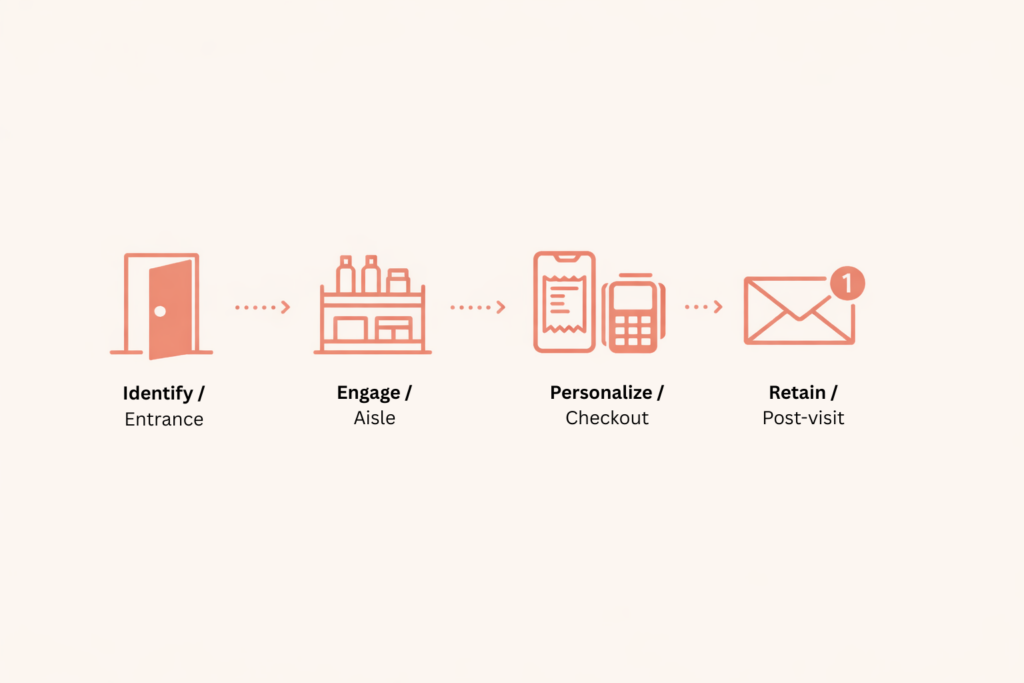
In-store customer identification and engagement follows a natural progression that maps to the physical journey through your store. The four stages are:
- Stage 1: Identify (Entrance and early journey) turns an anonymous visitor into a recognizable profile the moment they arrive.
- Stage 2: Engage (Aisle and browsing) captures intent signals and provides value during the visit, building behavioral context.
- Stage 3: Personalize (Checkout) converts the transaction into a data-rich, relationship-building moment.
- Stage 4: Retain (Post-visit) uses everything captured across Stages 1 through 3 to bring the customer back and deepen the relationship over time.
The critical insight is that these stages compound. Each one produces data that makes the next stage more effective. A retailer running only Stage 3 captures purchase data. A retailer running all four captures visit context, product interest, purchase behavior, and post-visit engagement, then feeds each layer into the next.
This is progressive profiling applied to the physical store. You don’t need everything at once. This is how retailers reach 50% to 60% identification rates without adding friction to any single interaction.
What can you capture at each stage? What does each stage make possible? And what are you losing by skipping it?
Stage 1: Identify. In-Store Customer Identification Before the Register
For most retailers, the customer visit starts anonymous and stays that way for the entire browsing phase. The first opportunity to capture identity comes at checkout, if the customer agrees. That means 30 to 60 minutes of foot traffic producing zero intelligence about who is in your store, what they’re interested in, or whether they’ve been here before.
Traditional approaches fail here because they all require pre-existing commitment. Loyalty cards need prior enrollment. Apps need a download, and retail app adoption rates remain stubbornly low. Staff-based email capture is inconsistent and friction-heavy. None of these work for the first-time visitor walking through your door right now. The industry has quietly accepted this as normal, which is remarkable when you consider that no e-commerce team would tolerate 90% of website visitors being completely untrackable.
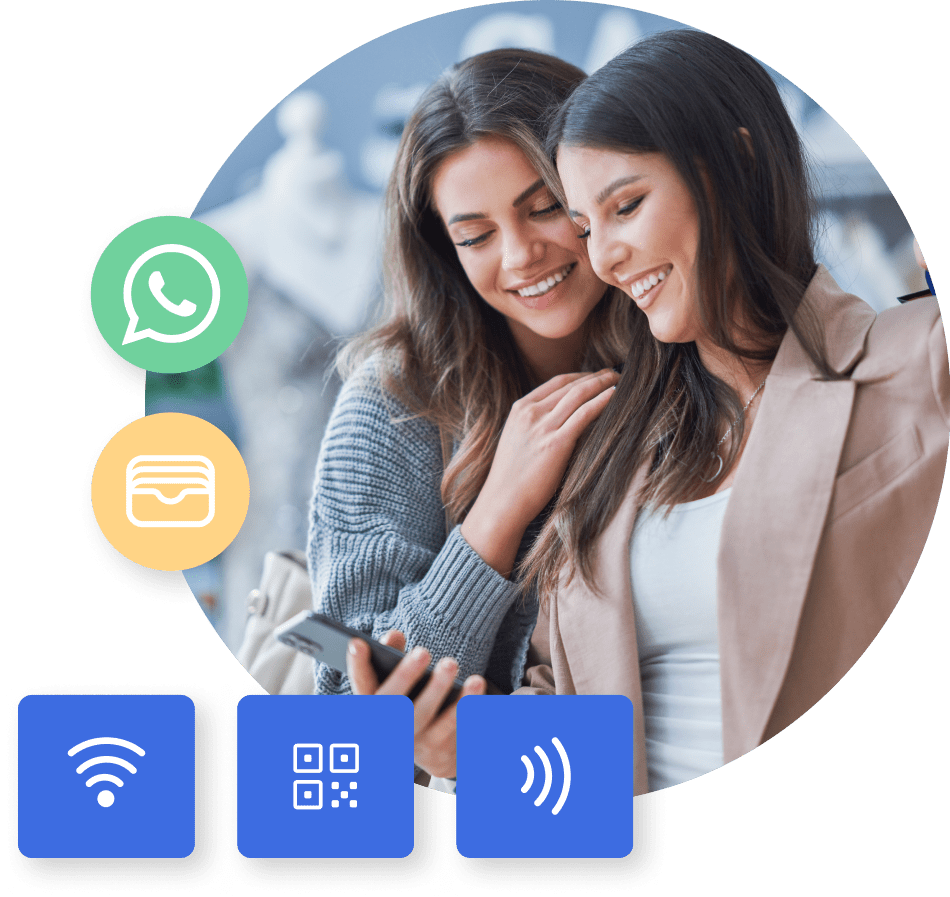
What does work: browser-based retail customer touchpoints that require no app and no prior relationship. QR-based check-in points near the entrance, NFC tap-to-connect stations, Wi-Fi captive portals, and digital store directories all create a first interaction that opens in the customer’s mobile browser. A single scan creates a device-level profile that can be recognized on the next visit. No personal information required at this stage.
This is where the two biggest objections get answered up front. “Our customers won’t download an app” becomes irrelevant because no app is involved. The interaction is browser-native and works on any smartphone. And for GDPR and privacy: progressive profiling starts anonymous by design. A device profile with no PII attached requires no consent. Personal data capture happens only later, when the customer explicitly opts in through a value exchange they choose. Compliant from the first scan.
What this data makes possible downstream is significant. Even anonymous device profiles give you visit frequency tracking, marketing-to-visit attribution (did the customer who saw your Instagram ad actually show up?), and the foundation for progressive profiling across future visits. The visitor who scans a store directory today becomes a recognized returning visitor next week, and an identified, opted-in customer the visit after that. Each interaction builds on the last, with the customer choosing when and how much to share.
Stage 1 is the base layer that every subsequent stage builds on. Without it, your store has foot traffic data but no identity layer beneath it.
Skip it, and every other stage operates cold-start. Your checkout identification still works, but without any visit context. You know what they bought. You have no idea how often they visit, what brought them in, or what they browsed before buying. Every customer walks up to your register as a stranger, even the ones who were here last Tuesday.
Stage 2: Engage. Capture Customer Data and Intent Signals During the Visit
When was the last time a customer spent 20 minutes browsing your store and you captured a single data point about what they looked at? Online, that same session would produce product page views, comparison behavior, scroll depth, and dwell time. In the physical store, it produces nothing.
This is the most overlooked gap in retail, and it’s strange when you think about it: retailers invest heavily in getting customers through the door, then have zero infrastructure to capture what those customers are actually interested in. Staff can observe, but they can’t record, scale, or connect observations to a customer profile. The browsing phase is the richest source of intent data in your store, and most retailers let it pass completely uncaptured.
Here’s where in-aisle touchpoints change the picture. Product or Shelf level QRs that link to detailed specifications, smart product assistants showing size availability and reviews, category information points, and style recommendation tools all serve the customer while simultaneously capturing intent data. Product interest signals, category affinity, size and variant preferences, comparison behavior: all of it now exists as structured data.
The principle that makes this work is value exchange. Customers interact with these touchpoints because they get something useful: a product video, a review summary, real-time stock availability across locations. The data capture is a byproduct of genuine service, not a form they’re asked to fill out. This distinction matters enormously for adoption rates. Customers scan QR codes when they get product reviews or size availability. They do not scan QR codes because a sign says “scan here.”
When Stage 2 compounds with Stage 1, the value multiplies. If you identified the visitor at the entrance, every product interaction during browsing is now attributed to a profile. You’re not just capturing aggregate product interest across all visitors. You know that this specific customer looked at three winter coats, compared two in the same size, and spent the most time on the most expensive option. Without Stage 1, you have anonymous browsing data. With it, you have individual intent profiles.
What this data feeds into downstream is equally powerful. Product affinity profiles inform checkout personalization in Stage 3 and targeted post-visit campaigns in Stage 4. Merchandising teams gain intelligence they’ve never had: which products get scanned but not purchased? Which categories generate the most engagement but the lowest conversion? That’s the kind of data that was previously exclusive to e-commerce product managers.
Skip Stage 2, and checkout becomes your only data source. You know what customers bought. You have no idea what they considered, what they compared, or what almost made it into the basket. Your post-visit marketing becomes generic because you have no behavioral signal to personalize against.
Stage 3: Personalize. The Checkout as Relationship Accelerator
Checkout is the single most powerful customer touchpoint in the store. No qualification needed. It reaches 100% of buyers, generates rich transaction data (products, spend, store location, time, payment method), and comes with a built-in expectation the customer already has: the receipt.
This is why checkout identification alone has massive ROI. Even without Stages 1 and 2, converting the checkout from an anonymous transaction into an identified relationship is one of the highest-impact changes a retailer can make. If you’re starting your in-store customer engagement program here, you’re starting in the right place.
The mechanism that makes this work at scale is the digital receipt. Every customer already expects a receipt. Making it digital, through a QR code on the payment terminal or screen, an NFC tap, or automatic linking via payment token, turns a document most people throw away into a persistent customer touchpoint. No new behavior required from the customer. No new ask from the cashier.
What the digital receipt captures in a single interaction: email address, phone number, marketing opt-in, loyalty enrollment, feedback, and personalized offers based on the transaction just completed. The best platforms in this category now achieve 60-70% receipt scan rates and 70-80% email capture among those who scan. Compare that to cashier-prompted “can I get your email?” programs that typically sit below 15%. The receipt does the work that used to fall on your checkout staff.
Two objections belong here, and both have cleaner answers than most retailers expect. Staff adoption is the first, and it’s the one that kills most in-store data programs before they start. The strongest checkout touchpoints are self-service. No staff training required. No behavior change. No new script for the cashier to remember during peak hours. The customer controls the interaction.
Integration complexity is the second. Modern receipt platforms connect to existing POS systems through standardized integrations, typically activating within days, not months. They feed data to your existing CRM or CDP rather than replacing it. This is not a rip-and-replace project.
Now, here is where the framework’s compounding logic becomes most visible. Checkout alone captures who bought and what they bought. Valuable. But when you add Stage 1, you also know how frequently they visit, including visits where they didn’t buy. When you add Stage 2, you know what they browsed, compared, and considered. Checkout identification is the foundation. Stages 1 and 2 are the multiplier.
Consider the alternative: a store where checkout remains a paper-receipt-only transaction. Zero identification. No CRM entry created. No email captured, no post-visit channel opened. Every buyer leaves exactly as anonymous as they arrived, and your only re-engagement strategy is hoping they walk past the window again. That’s the baseline most retailers are operating from today, and it’s the cost that makes checkout identification such a clear first move.
Think of it as a maturity curve. Checkout-only identification might reach a 30 to 40% known customer rate within six months. Adding entrance and aisle touchpoints can push that to 50 to 60% or higher within twelve months. The framework is aspirational. The starting point is pragmatic.
If you’re currently evaluating digital receipt platforms, or considering switching from a provider that isn’t delivering those capture rates, Stage 3 is the right place to focus first. Then expand as the data proves the model.
Stage 4: Retain. Use Captured Data to Bring Them Back
How different is the email your best customer receives from the one a first-time buyer gets? For most retailers, the answer is: identical. Both get the same newsletter, the same weekly promo, the same “we miss you” after 30 days of silence. Every store visit is treated as an isolated event, and the post-visit communication reflects it.
That changes completely with data flowing from Stages 1 through 3. A customer who browsed winter coats (Stage 2), bought a specific jacket (Stage 3), and has visited twice this month (Stage 1) receives a follow-up with care instructions for the jacket, a recommendation for complementary items like scarves or gloves from the category they browsed, and a personalized loyalty enrollment invitation based on their purchase frequency. That’s a different conversation than “20% off everything this weekend.”
What’s operationally possible at this stage: automated post-visit flows triggered by in-store behavior, including thank-you messages, product care tips, complementary recommendations, and review requests. Personalized re-engagement based on what they browsed and bought. Visit frequency-based segmentation that treats first-timers differently from regulars and re-engages lapsed customers before they disappear. Loyalty enrollment positioned as a natural next step after two or three identified visits, with enough context to make the invitation feel earned rather than generic.
This is where the system pays for itself. Reactivating a known customer costs a fraction of acquiring a new one. Closed-loop attribution becomes possible: campaign sent, store visit recorded, purchase confirmed. Customer lifetime value modeling gains real inputs: visit frequency, purchase history, browsing behavior, campaign response. The in-store profile merges with online behavior to create one customer, one story, across every channel.
The compounding effect across all four stages becomes clear when you compare the experience of a single customer over three visits. With checkout-only identification, each visit starts fresh. The third visit generates the same generic receipt and the same mass email as the first. With all four stages active, the third visit is informed by the first two: personalized offers at the entrance based on past purchases, relevant product recommendations in the aisle based on browsing history, a checkout experience that already knows their preferences, and post-visit communication that acknowledges their growing relationship with your brand.
Skip Stage 4, and the data you captured in Stages 1 through 3 sits unused. You’ve built the intelligence but never acted on it. The customer felt anonymous even though you knew exactly who they were.
How to Measure In-Store Customer Engagement (and Make the Internal Case)
Every KPI matters less than one: your known customer rate. What percentage of your store’s revenue comes from identified, reachable customers versus anonymous transactions? This is the north star metric that captures the system’s total impact in a single number your CEO can understand.
Beyond the north star, each stage has indicators that tell you whether it’s working:
- Identify: scan or tap rate at entrance touchpoints, new versus returning visitor ratio
- Engage: product interaction rate, browse-to-buy ratio by category
- Personalize: digital receipt adoption rate, email capture rate, marketing opt-in rate
- Retain: repeat visit rate, campaign-to-visit attribution, customer lifetime value progression
For benchmarking, here’s what the data shows across retailers who have built this kind of customer journey infrastructure. Most retailers start with a known customer rate below 10%, even those with active loyalty programs. With checkout-only identification (Stage 3) running well for six months, 30 to 40% is a realistic target. With multi-stage identification across entrance, aisle, and checkout running for twelve months, 60 to 70% and above is achievable. The curve is not linear; it compounds as returning customers are recognized faster across more touchpoints.
Those numbers are what make the internal business case concrete. If known customers spend 3x more and account for 76% of growth (per Shopify and EY’s data), then moving your known customer rate from 10% to 40% is not an engagement initiative. It’s a revenue strategy with a number your CFO can model.
Where to Start with In-Store Customer Engagement
Most retailers should start at Stage 3: checkout and digital receipts. It has the broadest coverage (every buyer passes through), the lowest implementation complexity, and the fastest return. Once you see the identification rate climb and the downstream data start informing your CRM, layering in Stages 1 and 2 becomes an obvious next step, not a leap of faith.
Before you do anything else, estimate your current known customer rate. Take last month’s revenue. What percentage came from customers you can identify and contact? That number is the gap between where you are and what the framework above makes possible.
If you’re at EuroShop 2026, refive is showing this four-stage framework live at Hall 7, Stand B04-10. Walk the journey from entrance touchpoint to digital receipt to post-visit automation and see the data flow in real time. Grab a time with us here.
If you’re reading this afterward, visit refive.io to see how the framework works in practice.