
Here’s a scene that plays out thousands of times daily: a customer walks in, browses for twenty minutes, buys something, and leaves. The transaction data hits your POS. But who was that person? What brought them in? Will they return? You have no idea. That customer just became another anonymous line item in your sales report.
This matters more than ever. Customer acquisition costs have surged 60% over the past five years. Meanwhile, physical stores still account for roughly 70% of retail sales. The math is simple but painful: most customers walk through your doors as strangers and leave the same way.
Progressive profiling offers a smarter path. Instead of demanding a customer’s life story at checkout, it builds knowledge gradually, one interaction at a time, always exchanging data for something useful.
Done right, it transforms anonymous shoppers into known, engaged customers without the friction that makes people abandon sign-up forms.
Why Retail Teams Need a New Approach to Customer Data
CRM and marketing teams face pressure from every direction. Personalisation isn’t a nice-to-have anymore; customers expect it. Privacy regulations keep tightening. Third-party cookies are disappearing. And acquisition budgets are being scrutinised like never before.
Yet the tools available often create more problems than they solve. Traditional sign-up forms ask for too much too soon. Research shows 27% of users abandon forms simply because they’re too long. In retail, this plays out daily: cashiers asking for emails, staff pushing loyalty cards, customers declining because they just want to pay and leave.
The result is a fractured view of your customers. Online, you might have rich behavioural data. In-store, you have transaction records with no identity attached. Your CRM contains email addresses from years ago. Loyalty members interact with one system while anonymous shoppers interact with nothing. These silos don’t just create reporting headaches; they make genuine personalisation nearly impossible.
Progressive profiling flips this script. Rather than forcing a choice between “unknown visitor” and “complete profile,” it creates a pathway where each touchpoint becomes an opportunity to learn something small but useful, always tied to a clear benefit for the customer.
So, What Is Progressive Profiling?
Progressive profiling means collecting customer data incrementally across multiple interactions, rather than all at once. Each time a customer engages with your brand, you ask for one small piece of information in exchange for something they actually want.
In SaaS and B2B marketing, this usually means gating content behind forms that ask different questions each time. In retail, the concept translates to something more practical: using every natural touchpoint in the customer journey to learn a little more, while making each ask feel like service rather than surveillance.
The Customer State Ladder
Think of customers moving through distinct stages of “knowability.”
Anonymous: You see their basket and store visited, maybe tag them with a receipt token or device ID. But you can’t reach them after they leave.
Identified: You have an email or phone number. You can contact them, but may not have marketing consent yet.
Opted-in: They’ve given explicit marketing permission. You’re starting to understand preferences.
Loyal member: You know purchase history, preferences, preferred stores, maybe sizes or household context. They’re engaged with your loyalty program or app.
Progressive profiling is the strategy for moving customers up this ladder, one step at a time, without pushing so hard they jump off.
Why Traditional Data Capture Fails Retail Customers
Standard approaches to customer data collection were designed for contexts that don’t match retail reality.
Consider what typically happens: a customer reaches checkout. The cashier asks about the loyalty program. Signing up means providing a name, email, phone, maybe birthday and address. There’s a queue forming. The whole thing takes a minute they don’t have. They say “no thanks” and you’ve lost them.
Or take online forms. Best practice says five fields is optimal, yet many retail forms ask for ten or more. Each additional field increases abandonment. People enter fake data just to get through, polluting your database with information you can’t actually use.
Then there’s the channel problem. Ecommerce gathers one set of data. Stores gather another, often inconsistently. Your CRM tries to reconcile but ends up with duplicates. A customer shopping both channels might exist as three different people in your system.
Perhaps worst: you’re missing micro-moments that could reveal intent or context. Someone compares two products for several minutes, checks a size and puts it back, looks up product reviews, asks a staff member a question, tries something on, or abandons a basket at the last minute. These signals happen constantly in every store but almost none of them are captured in a way that can inform personalisation, segmentation, or future marketing.
Principles of Good Progressive Profiling in Retail
Before diving into tactics, it helps to establish ground rules.
Start from the customer’s perspective, not your data wishlist. Every question should connect to something improving their experience. “What categories interest you?” makes sense if it means better recommendations. Asking for their birthday on first contact does not.
Ask only the minimum useful next question. One or two fields at a time. Choose questions that unlock immediate value, like preferred store or clothing size.
Tie every question to visible value. Convenience (easier returns), relevance (better suggestions), or access (early sale notifications). If you can’t articulate the benefit, don’t ask yet.
Stay consent-first and transparent. Clear opt-in language. Obvious purpose. Easy preference management. This isn’t just compliance; it’s about trust.
Design once, orchestrate across channels. The same customer profile and profiling logic should work whether someone interacts via digital receipt, app, kiosk, or website.
The Progressive Profiling Journey: From First Visit to Loyal Customer
Let’s walk through what this looks like in practice.
Stage 1: From Unknown to Anonymous Shopper
Before any contact details, you can still learn something. The customer is browsing, exploring, deciding. Your goal is to create a tagged session that captures behavioural signals without requiring identification.
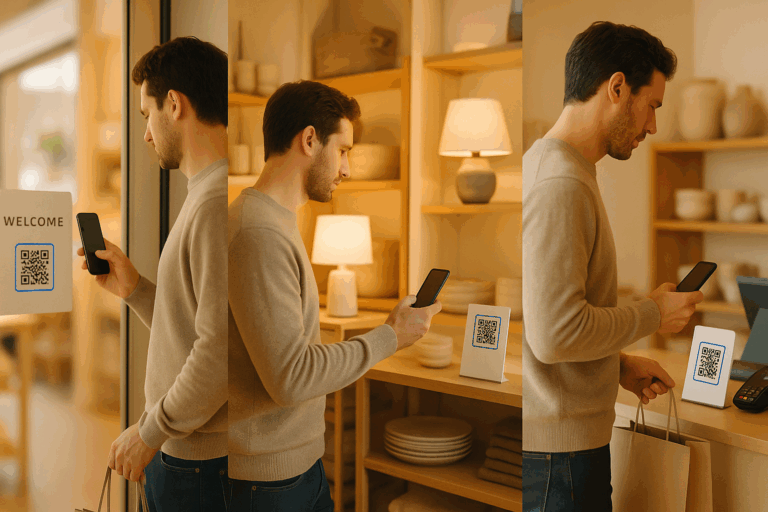
In-store touchpoints work well here. A customer interacts with a product assistant by scanning a QR code on a product tag. They interact with a digital store concierge for directions or product availability. They connect to WiFi with a simple one-tap acceptance. Each of these creates a session token that links their in-store behaviour to a trackable profile, even though you don’t yet know who they are.
What you’re learning at this stage: which products they examined, which aisles they browsed, what questions they asked, how long they spent in store. This is zero-party behavioural data, captured anonymously and compliantly.
Focus on creating a helpful, friction-free interaction that makes them want to come back – even if they don’t purchase anything right away.
Stage 2: From Anonymous to Identified
This is where you earn a contact point. The trick is choosing the right moment and the right ask.
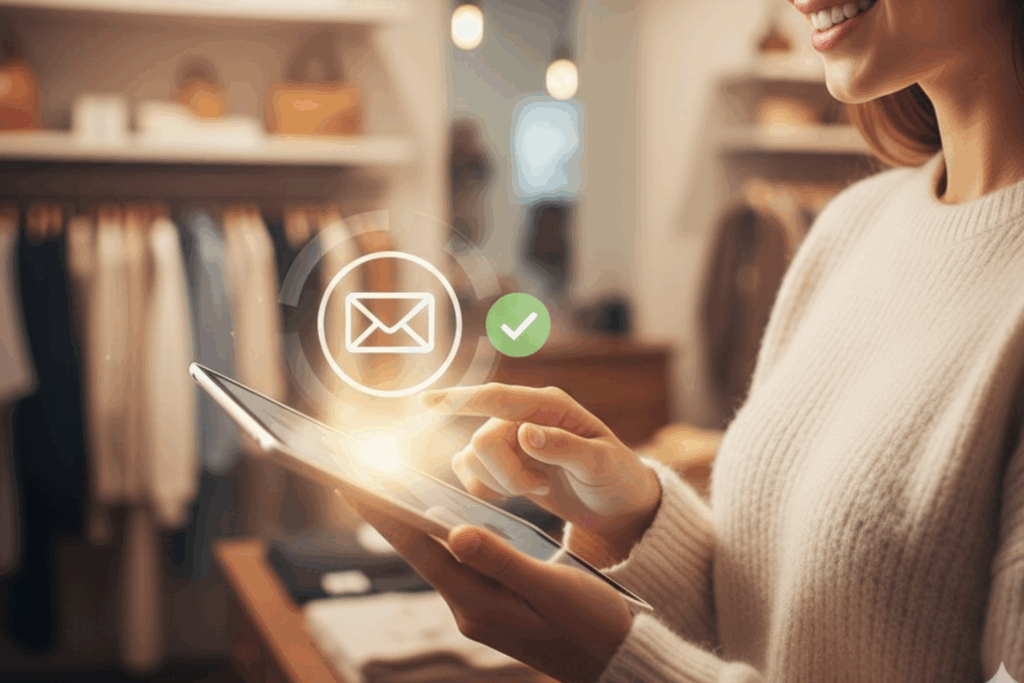
Digital receipt flows work well: “Enter your email to save this receipt and access it anytime.” Post-purchase surveys with a small incentive. Warranty registration. Back-in-stock alerts for sold-out items. ‘Complete the look’ suggestions.
Make it super easy to opt-in. The value exchange should be concrete: receipt access, order history, easier returns, or saving favourite sizes.
Stage 3: From Identified to Opted-In
Now you have contact information. The next step is explicit marketing consent and the beginning of real preference data.
Follow-up journeys help here. A first email or WhatsApp after purchase. A simple in-message poll asking about style preferences. Each touchpoint adds one or two data points: preferred channel, categories of interest, and more.
Don’t infer sensitive attributes. Use plain language. If a customer feels you know too much too soon, you’ve lost trust that won’t easily return.
Stage 4: From Opted-In to Loyal Member
Now deeper profiling becomes appropriate. Budget preferences. Key occasions like birthdays. Detailed size information. Household context where relevant.
Loyalty onboarding, app prompts, and periodic “profile refresh” check-ins work well. Frame it as service: “Help us fine-tune your experience.” Show visible benefits: early access to drops, personalised bundles, relevant content. The goal is a customer who feels understood, not watched.
Retail Touchpoints for Progressive Profiling
Every customer interaction is a potential data moment. Here’s where to look.
Store entry: WiFi sign-up. Offers of the day. Quick preference selections.
In-store: Product/shelf QR codes. Kiosks. Digital product assistants asking context-appropriate questions like “Shopping for yourself or a gift?” for better suggestions.
At checkout: Digital receipts via QR code. Simple “send receipt to” flows. Wallet pass creation.
Post-purchase: Surveys, reviews, and feedback requests. Warranty registration. “Complete your profile” prompts with clear incentives.
Returns and service: Great moments to update details, ask what went wrong, and refine preferences.
Loyalty and apps: Richer profile completion over time. Sizes, wishlists, store preferences, occasion reminders.
Orchestrating With Your CRM & CX Stack
Progressive profiling only works if the data actually connects.
Start with a single customer ID that persists across channels. Many retailers have separate identifiers for POS, ecommerce, loyalty, and email. Reconciliation requires matching rules: same email, receipt token, device ID, or loyalty number.
Design your data schema for growth. Build fields for attributes you might not have today. Plan for “unknown to known” transitions where an anonymous session gets linked to an identified profile. Track consent explicitly.
Set up automated flows triggered by customer state changes. When someone becomes identified, trigger a welcome sequence. When marketing consent is captured, adjust targeting. When a key attribute is missing, ask in the next interaction.
Your POS, ecommerce, CRM, email service, and loyalty solution all need to share a common customer view. This isn’t about choosing one tool; it’s about ensuring they talk to each other.
Privacy, Consent, and Trust
Trust is the real asset here. Long-term customer lifetime value depends on customers believing you’ll handle their data responsibly. Short-term list growth at the expense of trust is a bad trade.
Ground rules: explicit opt-in for marketing, purpose limitation, data minimisation, easy opt-out, and awareness of regional compliance.
Design “just-in-time” consent. Short, clear notices at data capture explaining why you’re asking. Avoid pre-ticked boxes, hidden fields, or forced inputs that aren’t necessary.
Measuring Success
If you can’t measure it, you can’t improve it.
Funnel metrics: Track how effectively shoppers move through each stage of your profiling ladder. Anonymous-to-identified rate. Identified-to-opted-in rate. Opted-in-to-loyalty rate.
Data quality: Field completion rates by attribute and channel. Hard bounces and invalid contacts. Duplicate profile rates.
Business impact: Campaign performance by profile richness. CLV and repeat purchase rates by customer state. Unsubscribe rates if you’re pushing too hard.
Run experiments. A/B test question order, incentive types, and channel mix. Let data guide adjustments.
Common Pitfalls (And Better Alternatives)
Asking for everything at once “just in case.” Only collect data you’ll use within the next quarter. If you might need it someday, wait until that day.
Treating each channel as separate. Conflicting forms and duplicated asks are symptoms of siloed thinking. Centralise profiling logic.
Training customers to share data only for discounts. Discount-driven incentives create expectation problems. Balance transactional rewards with experience-based value.
Ignoring store teams. Beautiful journeys designed in conference rooms break on busy shop floors. Involve frontline staff early.
Collecting but never using. Profiles that don’t improve campaigns or service are just expensive databases. Close the loop.
How to Get Started
If you’re starting from scratch, here’s a practical approach.
Audit what you have. Existing forms, receipts, loyalty flows, surveys. What fields exist? What are opt-in rates? Where are the gaps?
Define your ladder. What does “anonymous,” “identified,” “opted-in,” and “loyal member” mean for your business specifically?
Choose priority touchpoints. Digital receipts, first post-purchase email, and loyalty onboarding are often good starting points.
Design the next best question at each step. One field per stage that improves segmentation or CX visibly.
Align with legal and data teams. Check consent language, storage, access, and retention policies.
Launch, measure, adjust. Set baselines. Run small tests. Refine. Then scale across channels.
Quick Checklist: Are You Ready?
Before you begin, ask yourself:
- Do we know our customer state ladder and what each stage means?
- Do we have a single customer ID across channels?
- Do we know what missing data would actually change decisions?
- Do we have clear value exchanges for each major step?
- Are consent, privacy, and governance clearly defined?
- Do we have KPIs and feedback loops in place?
If you can answer yes to most, you’re ready to start building. If not, you know where to focus first.
Progressive profiling isn’t a one-time project. It’s an ongoing practice of earning customer trust, one question at a time, and using what you learn to serve them better. Get that right, and you’ll turn anonymous shoppers into the loyal customers every retail team wants.
- Is progressive profiling legal under GDPR and other privacy regulations?Yes, when done correctly. Progressive profiling is actually well-suited to privacy compliance because it follows data minimisation principles (collecting only what you need, when you need it). The key requirements: obtain explicit consent before collecting personal data, clearly explain why you're asking for each piece of information, provide easy opt-out options, and store data securely with documented legal basis.
- How long does it typically take to see results from progressive profiling?Most retailers see measurable improvements within 3-6 months. Early wins include higher opt-in rates (since you're asking less upfront) and cleaner data quality. Meaningful profile depth and the ability to run more targeted campaigns typically develop over 6-9 months as customers move through multiple interactions. The timeline depends heavily on your transaction frequency and how many touchpoints you activate.
- Can progressive profiling work without a loyalty program?
Absolutely. Loyalty programs are just one mechanism for progressive profiling. You can build customer profiles through digital receipts, warranty registrations, back-in-stock alerts, post-purchase surveys, WiFi sign-ups, returns, and other natural touchpoints. The key is having a unified customer ID and consistent profiling logic across channels.
- What's the difference between progressive profiling and traditional loyalty program sign-up?Traditional loyalty sign-up asks for everything at once, usually at checkout, in exchange for future rewards. Progressive profiling spreads data collection across multiple interactions, asking for one or two pieces at a time, with immediate value at each step. The result: less friction, better completion rates, higher data accuracy, and profiles that grow richer over time rather than remaining static after initial sign-up.
- What's the biggest mistake retailers make when implementing progressive profiling?div]:bg-bg-000/50 [&_pre>div]:border-0.5 [&_pre>div]:border-border-400 [&_.ignore-pre-bg>div]:bg-transparent [&_.standard-markdown_:is(p,blockquote,h1,h2,h3,h4,h5,h6)]:pl-2 [&_.standard-markdown_:is(p,blockquote,ul,ol,h1,h2,h3,h4,h5,h6)]:pr-8 [&_.progressive-markdown_:is(p,blockquote,h1,h2,h3,h4,h5,h6)]:pl-2 [&_.progressive-markdown_:is(p,blockquote,ul,ol,h1,h2,h3,h4,h5,h6)]:pr-8">_*]:min-w-0 standard-markdown">
Collecting data they never actually use. Many retailers build detailed profiles but never connect the information to campaigns, personalisation, or improved service. This wastes customer goodwill (they shared data expecting value in return) and creates compliance risk (holding data without clear purpose). Before asking any question, define exactly how the answer will change your marketing, operations, or customer experience within the next quarter.