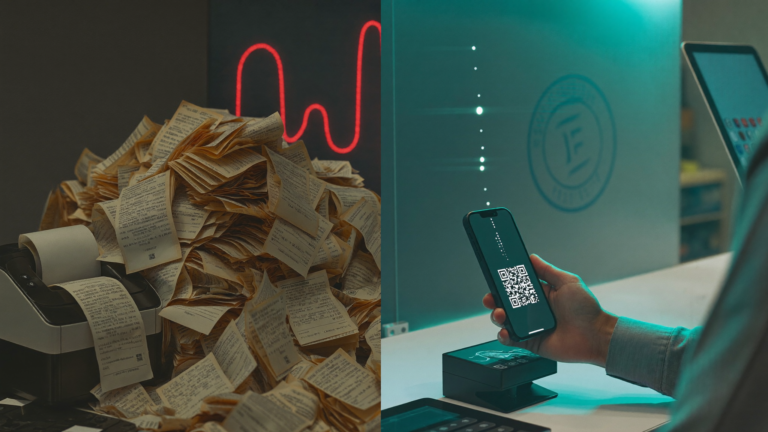

A woman walked out of IKEA carrying a receipt 4.34 metres long. The printer kept running long enough that the cashier worried the roll would not last. Berlin media covered the story. Customers photographed it. The receipt became a minor viral moment, passed around because it was so visibly absurd.
It was not a malfunction. It was the system working exactly as designed. Every item scanned, every VAT rate calculated, every fiscal security signature generated, every loyalty summary and promotional line appended at the foot. The machine did precisely what German law and retail convention required of it.
Why are retail receipts so long? The answer is not one reason. It is six. And once you understand what is actually on that 4.34-metre strip of thermal paper, the more interesting question becomes: why is any of it still being printed on paper at all?

The Six Reasons Your Receipt Is So Long
Why is my store receipt so long? Because a modern retail receipt is not a single document. It is six, printed end to end on the same roll of thermal paper, each layer either legally required or commercially justified.
1. Itemised VAT
German law requires each VAT rate to be broken out separately per line item. A large IKEA shop with mixed categories, furniture at 19% and food items at 7%, generates a tax line for every item in the basket plus a VAT summary at the foot. A basket of forty items across two rates produces dozens of VAT lines before anything else is printed. This is not bureaucratic excess. It is the foundation of German fiscal compliance.
2. Fiscal Security Data
Since January 2020, every receipt in Germany must carry TSE (Technische Sicherheitseinrichtung) fiscal security data under the Kassensicherungsverordnung. From January 2024, the requirements became stricter. Before 2024, retailers could choose between printing the serial number of the electronic recording system or the TSE security module. From January 2024, both must appear, alongside two newly mandatory fields: the signature counter (Signaturzähler) and the check value (Prüfwert). German receipts did not get shorter in 2024. They got longer. All of this is anti-fraud infrastructure, designed to make cash manipulation detectable during a Kassen-Nachschau inspection.
3. Payment Processing Lines
Card payment, terminal ID, authorisation code, card type, masked card number. Each element is a separate printed line. For a split payment or a card decline followed by a retry, this section doubles. These are terminal protocol requirements, not retailer choices.
4. Return and Warranty Policy
Most European markets require return policy disclosure at point of sale. Retailers print it in full on every transaction. For IKEA, with its generous return policy and product-specific conditions, this is a paragraph, not a line. For electronics retailers, legal guarantees of conformity under European consumer law add further text.
5. Loyalty Programme Terms
If the retailer operates a loyalty programme, the terms or points summary appears here. Membership details, bonus point conditions, and upcoming promotional mechanics add several lines. For a retailer running a tiered programme with quarterly thresholds, this section alone can run to eight lines.
6. Promotional Content
Current offers, upcoming sales, survey invitations, QR codes for feedback, promotional codes for next visit. This is discretionary, but almost every large retailer includes it. The receipt has become the last available advertising space in the physical store.
Every one of these layers is mandatory or commercially justified. None of them require paper.
The Format Is the Problem, Not the Content
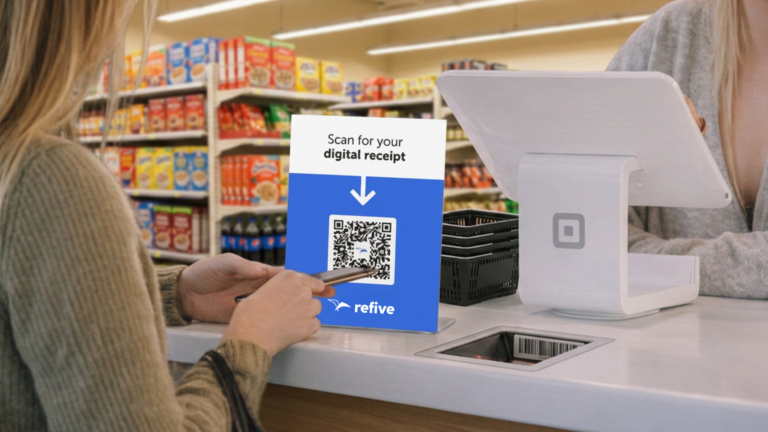
Every mandatory element on a 4.34-metre paper receipt fits inside a QR code. The fiscal security data, the VAT breakdown, the transaction reference, the return policy, the sequential transaction number. A QR code conforming to DSFinV-K specifications carries the full compliance payload in a format that takes two centimetres at the checkout display.
The paper version complies and stops. The digital version complies and starts a customer relationship.
Digital receipts achieve opt-in rates of 75-80% at point of purchase. Ecommerce marketing emails average 30.70% open rates according to the Omnisend 2026 Ecommerce Marketing Report. The receipt is not just the highest-engagement post-purchase touchpoint most retailers possess. For retailers printing paper receipts, it is the highest-engagement touchpoint they are systematically delivering to a bin.
Retailers looking to replace paper receipts in retail are often surprised to find that the compliance requirement was never the barrier they assumed. The compliance obligation and the paper format have been treated as the same thing for so long that most people stopped examining the assumption. They are not the same thing. They have never been the same thing.
Europe’s regulators have reached the same conclusion. The legislation is already moving.
If you want to see what this looks like in practice, refive’s demo takes three minutes.
What European Regulation Actually Says About Paper Receipts
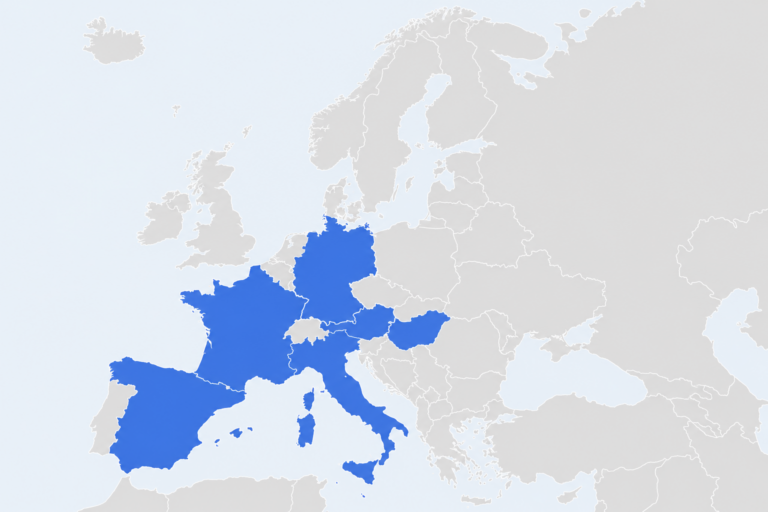
Paper receipt regulation across Europe is converging on a single model. Three of the continent’s largest retail markets are already in different stages of the same transition.
Germany: Receipts Are Mandatory. Paper Is Not.
Germany requires a receipt for every transaction. It does not require that receipt to be paper.
The Belegausgabepflicht, enacted under § 146a Abs. 2 AO and implemented through the Kassensicherungsverordnung, has required a receipt for every electronic POS transaction since January 2020. The explicit purpose is tax transparency and fraud prevention: state finance ministries cited by the Bundesrechnungshof (2024) estimate cash manipulation costs Germany up to €10 billion in lost tax revenue annually. Retail receipt compliance in Germany does not mandate paper. Digital receipts satisfy the obligation in full under § 6 Satz 3 KassenSichV, with the customer’s tacit consent.
The April 2025 CDU/CSU-SPD coalition agreement states plainly: “Wir schaffen die Bonpflicht ab.” They are abolishing the receipt obligation. The replacement, taking effect from 1 January 2029, is mandatory digital receipt issuance. Under the phased timeline, businesses above €100,000 annual turnover must operate mandatory electronic registers from 1 January 2027, with general application to all businesses from 2029. Paper is not simply being made optional. It is being phased out of retail entirely. The Belegausgabepflicht remains fully in force until then.
The printer is not a compliance requirement. It is a habit.
Read More: Digital Receipts vs Paper Receipts: What’s Best for Modern Retailers?
France: Paper Is Now the Exception
France banned automatic paper receipt printing from 1 August 2023 under Article 49 of Loi AGEC, codified at Article L. 541-15-10 IV of the Code de l’environnement. Retailers can offer paper on customer request. They cannot print by default. The French anti-waste law was the first national legislation in Europe to flip the default.
The average hypermarket consumed over 10,600 rolls of thermal paper per year before the ban (Mastercard Europe, 2024). Two years in, consumer adaptation has been clear: 75% of French consumers now support the elimination of paper receipts, up from 53% in a 2022 survey, according to OpinionWay/Perifem (September 2024). The environmental pressure was the trigger. The business opportunity is what kept retailers engaged.
Italy: Following from 2027
In June 2025, Italy’s parliamentary Finance Commission unanimously approved a resolution committing the government to a phased exit from paper receipts: large retailers by 1 January 2027, all merchants by 1 January 2029. Paper would remain available on customer request, mirroring the French model. Italy’s digital infrastructure makes this transition manageable: mandatory e-invoicing via the Sistema di Interscambio has applied to all VAT-registered businesses since January 2024.
The Italy paper receipt ban 2027 direction is confirmed. The timeline may shift. The parliamentary resolution commits the government to act, but implementing decrees had not been published as of March 2026. Treat Italy as directional, not confirmed law.
Paper receipt regulation across Europe is moving in one direction: digital by default, paper by request.
What Smart Retailers Are Doing Instead
The question is not whether to make the switch. It is how to extract the full value from it once made.
Same Compliance, Different Container
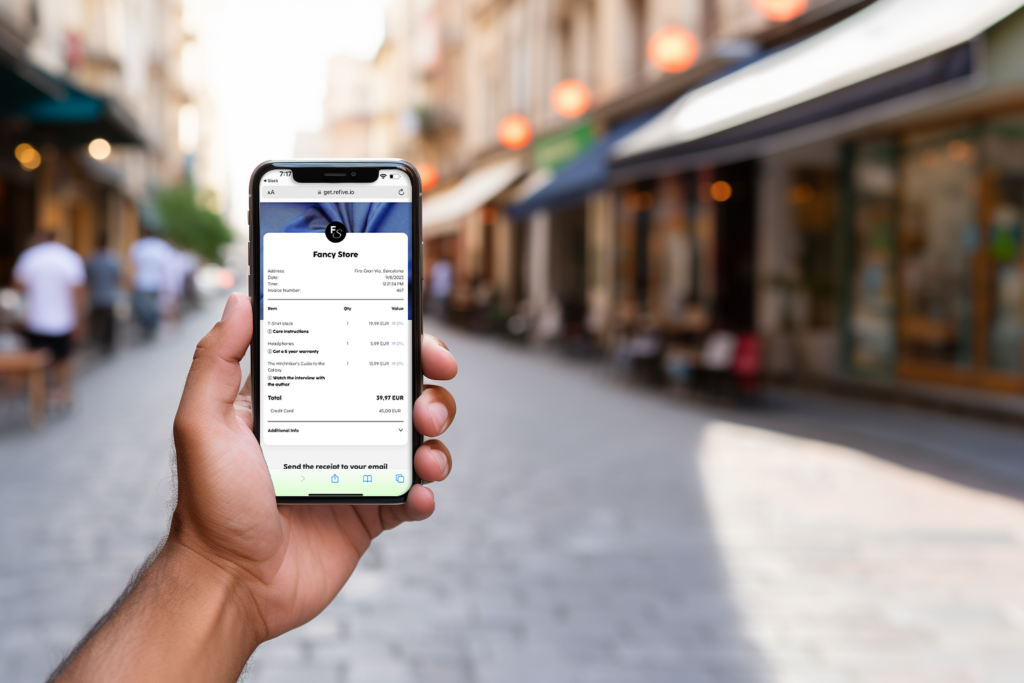
A compliant digital receipt in Germany, France, or Italy carries every field its paper equivalent carries. The full business name and address. Transaction date and time. Itemised goods and services. Sequential transaction number. VAT breakdown by rate. Serial numbers of both the electronic recording system and the TSE security module. The TSE signature counter. The check value. All of these fields can be carried in a browser-based receipt or QR code conforming to DSFinV-K specifications. The printer is the only thing that disappears.
What the Engagement Layer Adds
This is where the KPIs of a CRM manager or Head of Digital come into direct contact with the checkout.
A digital receipt delivered via QR code at the point of purchase captures email with marketing opt-in, with retailers collecting data on 50-80% of in-store customers at strong performance levels. It offers one-click loyalty enrolment directly in the receipt, removing the cashier ask. It displays personalised offers based on basket contents. It collects customer feedback and routes positive responses to Google Reviews. It fires attribution pixels to Google and Meta, connecting online ad spend to in-store purchases for accurate ROAS measurement. And it produces a 5-6% repeat purchase rate from receipt-triggered post-purchase campaigns.
Non-loyalty shoppers engage with digital receipts at a 51% higher click-through rate than loyalty programme members. The customers most worth converting are the most likely to respond.
This Might Interest You: Digital Receipts as a Retail Media Channel: The Future of In-Store Marketing
No App Required
The most common objection to digital receipts is the friction of asking customers to download something. There is no download. The experience is browser-based. A customer scans a QR code displayed on the checkout screen or payment terminal and receives their receipt immediately in a mobile browser. No registration is required for the receipt itself. Identification happens progressively as the customer opts in, building from anonymous profile to identified contact to loyalty member.
For retailers with an existing app, the digital receipt becomes an adoption driver rather than an alternative. A prompt embedded in the receipt experience, contextual and post-purchase, converts browser interactions into app downloads at a moment when the customer is already engaged.
Implementation
Improving in-store customer engagement through digital receipts typically takes under thirty days to deploy. Integration is POS-agnostic, and retailers choosing to switch digital receipt providers or migrate from paper will find the technical barrier lower than assumed. The platform connects to existing CRM, CDP, and marketing systems, feeding in-store transaction data into the stack you already have. Puma’s migration from Eyos to a new digital receipt platform demonstrates what enterprise-scale deployment across multiple markets looks like in practice. The cost reduction from digital receipt implementation is estimated at 15-25% within six months (The Retail Exec, October 2025). Retailers focused on how to reduce paper receipt costs consistently find that the operational savings are the floor, not the ceiling. The CRM growth and repeat purchase uplift that follows is where the returns compound.
Retail receipts carry six distinct layers of content: itemised VAT, fiscal security data, payment processing lines, return and warranty policy, loyalty programme terms, and promotional content. Each layer adds physical length to what most customers assume is a simple transaction record. German law tightened fiscal security requirements in January 2024, adding a mandatory signature counter and check value, making receipts longer still.
Yes. Since January 2020, Germany’s Belegausgabepflicht permits digital receipts with the customer’s tacit consent under § 6 Satz 3 KassenSichV. The obligation is to issue a receipt, not to print one on paper. A compliant digital receipt satisfies the KassenSichV requirements in full. Germany’s April 2025 coalition agreement goes further: mandatory digital receipt issuance replaces the current obligation entirely from 1 January 2029.
A compliant digital receipt in Germany must include the full business name and address, transaction date and time, itemised goods and services, sequential transaction number, VAT breakdown by rate, serial numbers of both the electronic recording system and the TSE security module, the TSE signature counter, and the check value. All of these fields can be carried in a QR code or browser-based receipt conforming to DSFinV-K specifications. The mandatory data may be presented in human-readable form or encoded in a QR code; both satisfy the Kassensicherungsverordnung.
France made the switch mandatory in August 2023 under Loi AGEC. Italy’s parliamentary commission committed to following from 2027 for large retailers and 2029 for all merchants, though implementing decrees had not been published as of March 2026. Germany has permitted digital receipts since 2020 and has committed to mandatory digital issuance by 2029. Retailers in these markets are deploying QR-code-based digital receipt platforms that satisfy compliance while adding customer engagement capabilities that paper cannot provide.
Digital receipts capture customer data at the point of purchase without requiring a loyalty card, app download, or cashier ask. A customer scans a QR code to receive their receipt in a mobile browser. From that interaction, the retailer can capture email with opt-in, build an anonymous profile that enriches progressively across multiple visits, and trigger post-purchase campaigns based on actual basket data. The result is a first-party data asset built entirely from in-store transactions, without a single cashier conversation or app install.
The Receipt Has Not Changed. Everything Around It Has.
Patricia’s 4.34-metre receipt was not a failure of technology or an oversight by a retailer that should have known better. It was the logical output of a system that added mandatory fiscal security fields in January 2024, has accumulated compliance requirements for three decades, and has not fundamentally changed its physical format since the thermal printer was introduced. The compliance requirement is not going away. The paper format is.
Most retailers we speak to are printing receipts that satisfy compliance and nothing else. If you want to see what the same compliance requirement looks like when it works for your CRM instead of your printer, that is what the refive demo shows.