
E-invoicing for fuel retailers is about to collide with a second mandate, and few retail verticals are as exposed to both. One European law governs the customer receipt at the pump. The other governs the business invoice. The deadlines are already set. Networks that meet them on one receipt workflow turn a compliance cost into a customer relationship. Networks that buy a separate tool for each rule pay twice. Here is the case for the first approach, and what “compliant” actually requires.
Two mandates: digital receipts and e-invoicing
Two separate laws are converging here, and they do different jobs. The digital-receipt mandate is consumer-facing: it stops retailers printing a paper receipt by default. The e-invoicing mandate is business-facing: it requires business-to-business invoices as structured electronic data, rather than paper or a PDF. A forecourt issues both. The private driver gets a receipt. The haulage fleet needs an invoice. Confusing the two scopes the wrong project. They do not overlap: in Germany, according to the European Commission, the e-invoicing mandate covers domestic B2B only and there is no B2C mandate, so the consumer till receipt (Kassenbon) at the pump sits outside it.
The deadline wall
The deadlines are fixed and close. Most multi-country fuel networks are already inside two or three of them.
- France. Automatic receipt printing has been banned since 1 August 2023 under the AGEC anti-waste law. Separately, B2B e-invoicing issuance becomes mandatory for large and medium firms from 1 September 2026, and small and micro firms from 2027.
- Italy. A phased paper-receipt ban hits large retailers from 1 January 2027, then 2028, with all merchants by 2029, on top of e-invoicing via the SDI platform since 2019.
- Germany. Firms have had to receive e-invoices since January 2025; issuing is mandatory for firms above €800,000 turnover from January 2027, and all firms from January 2028, under the Growth Opportunities Act.
- EU. Under VAT in the Digital Age (ViDA), structured e-invoicing for intra-EU cross-border B2B becomes mandatory from 1 July 2030, and a valid e-invoice becomes a condition for reclaiming VAT.
The customer side of this shift is covered in our piece on digital receipts versus paper receipts.
Why fuel is the most exposed vertical
Three structural reasons put fuel ahead of other retail on this.
- Volume. A busy forecourt issues a very high number of receipts, so paper cost (industry estimates put it around two cents each) is a line item before any mandate forces the change.
- Business mix. Fuel carries one of the highest B2B and fleet shares in retail, which is what makes the invoice obligation bite. Fleet-card data (DKV, UTA, Routex) flows to the card issuer, not the station operator, who still owns issuance.
- Cross-border. Fleets fuel across borders, so one network has to satisfy German, French, Italian and Polish invoice formats at once.
What “compliant” actually requires
Three things: issue the receipt digitally, issue the invoice in the right structured format, and archive both to standard.
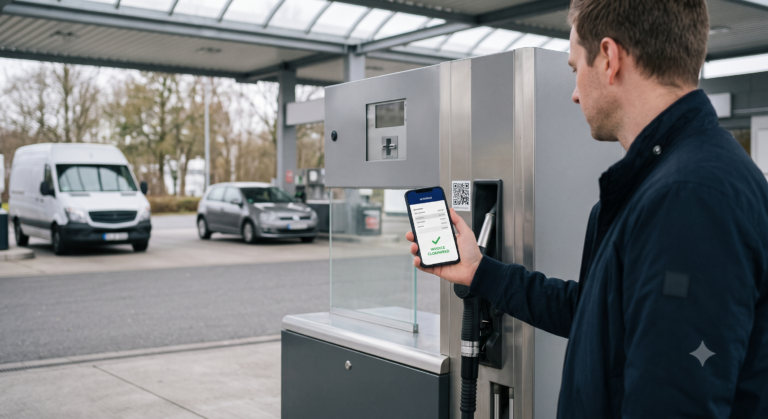
Issuance has to hold up on a live forecourt. The receipt loads in the customer’s browser from a QR code on the terminal or screen, an NFC tap, or an email fallback, with no app to download. No app matters for adoption and for support load. Issuance also has to tolerate the connectivity forecourts actually have: dynamic QR, on-screen input, and queue-based collection keep capture working when a site drops offline. At network scale, this depends on POS-agnostic integration and no new hardware, which is what lets a rollout happen in weeks rather than as a capital project.
Formats are where the work is. A compliant e-invoice is structured data to the European standard EN 16931, not a PDF. In Germany that means XRechnung (pure XML) or ZUGFeRD (a hybrid PDF with embedded XML). Cross-border, add Factur-X in France, FatturaPA in Italy, and KSeF in Poland, often transmitted over Peppol. One driver crossing three borders can trigger three format requirements against a single network.
Archive is the part most people forget. German GoBD rules require records kept immutable, machine-readable and audit-proof, with e-invoices retained in their original electronic format for up to eight years. The archive has to hold the structured data, not a printout of it, and the obligation sits with the operator regardless of who issues the invoice.
The trap: a tool per mandate
The instinct is to solve each rule as it lands. A receipt tool when the printing rules arrive. An invoicing tool for the B2B mandate. An archive for the auditor. A lookup page when customers call about lost receipts. On one site, fine. Across a multi-brand network on mixed POS hardware (HUTH, Scheidt & Bachmann, Gilbarco), it becomes four integrations to certify and maintain, each vendor updating on its own schedule, and the next mandate reopens the whole build. Every mandate solved separately is a mandate solved twice.
The one-workflow model
Attach all four jobs to the one thing every transaction already produces: the receipt.
- Digital receipt. The customer record, delivered to the device. The carrier.
- Compliant e-invoice. Issued to the business customer at the point of payment, in the right national format, not rebuilt at a counter or at month-end.
- Receipt archive. Internal reissue and after-the-fact e-invoice, held to the retention standard the law sets.
- Receipt finder. Customer self-service retrieval, which takes lost-receipt calls off your support queue.
One rail, four obligations. The model holds for any operator on any platform, and that vendor-neutrality is what makes it worth building once rather than buying four times. For an evaluation checklist, see the retailer’s guide to digital receipt software.
From obligation to asset
The same digital receipt that satisfies the mandate is the only identified, universal touchpoint a forecourt has. Every customer gets one. No app is required to receive it. The forecourt is also one of the most anonymous high-traffic environments in retail: industry estimates suggest up to around 70% of fuel customers never enter the shop, and pay-at-pump erodes the in-store moment further. A digital receipt is where an anonymous fuel stop becomes a known, opted-in customer. Compliance forces you to digitise the receipt. What it carries after that is your decision. We go deeper in how fuel retailers are building smart forecourts.
Proof: ORLEN Deutschland
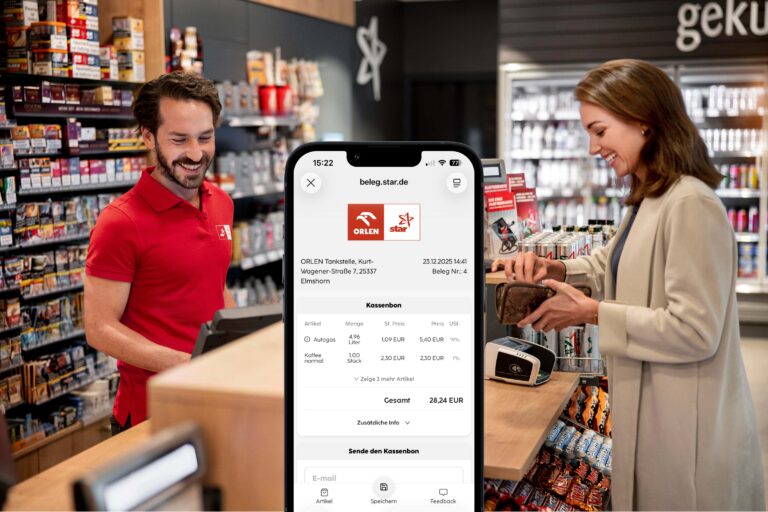
ORLEN Deutschland took the one-workflow route across its German estate. In the rollout we ran, refive’s digital receipt platform went live across more than 600 stations, with compliant e-invoices for fleet accounts, a customer-facing receipt finder, and an internal receipt archive for reissue across the network. The integration ran through ORLEN’s existing HUTH POS and the tankstar SDK with no infrastructure changes, which is the real test of whether a network-scale rollout is feasible. refive’s published figures expect, at full run, removal of around 36,000 kilometres of thermal paper, 300 tonnes of CO2, and 132 tonnes of waste a year. ORLEN Deutschland’s CFO, Andreas Trost, called it a move that makes the stations “faster, more digital and more sustainable.” The point is not the logo. Compliance, fleet invoicing, archive and finder arrived together, on one rail, with no hardware project.
Where to start
The mandates are set; the open question is whether your network meets them as one workflow or a growing stack of point tools. A receipt and e-invoicing readiness check maps your formats, markets and POS estate against what is coming.
Frequently asked questions
Receiving structured e-invoices has been required since January 2025. Issuing them is mandatory for firms above €800,000 turnover from January 2027, and for all firms from January 2028, under the Growth Opportunities Act. Most established networks fall into the 2027 group.
No. Germany’s e-invoicing mandate applies to domestic B2B transactions, with no B2C mandate. The consumer till receipt at the pump is outside it. Customer digital receipts follow from separate rules and from sustainability goals, not from the e-invoicing law.
XRechnung and ZUGFeRD, both built on EN 16931. A network serving cross-border fleets also meets Factur-X in France, FatturaPA in Italy, and KSeF in Poland, frequently over the Peppol network.
Under GoBD, records must be immutable, machine-readable and audit-proof, with e-invoices kept in their original electronic format for up to eight years. The archive has to hold the structured data, not a printout or screenshot.
Yes. From 1 July 2030, structured e-invoicing and digital reporting become mandatory for intra-EU cross-border B2B, and a valid e-invoice becomes a condition for reclaiming VAT. For cross-border fleets, that raises the cost of getting the format wrong.
Yes. The customer receipt and the business e-invoice can issue from the same workflow at the point of payment, alongside an archive for reissue and a finder for self-service. That is the alternative to a separate tool for each obligation.