
Fuel-to-shop conversion is the largest lever on a forecourt’s profit, because fuel margin sits near zero and the shop is where a station actually earns. Yet an industry-estimated 65 to 75 percent of the people who fuel up never come inside. The highest-margin sale on the site leaves with them, anonymous, and you cannot grow a shop full of strangers.
You already see this in your own numbers. You have spent on food-to-go, coffee, lighting, layout, and a loyalty app, and the fill-up customer still pays at the pump and leaves without a name attached. The forecourt is the most anonymous high-traffic retail environment in Europe, and that anonymity is the ceiling on every shop KPI you are measured against: forecourt conversion rate, basket size, repeat visits.
This piece lays out a three-move model to lift that ceiling. Identify the customer at the receipt. Convert them with a coupon into a higher-margin basket. Monetise them through identified, closed-loop retail media. It closes with the shift that widens the prize rather than shrinking it: the move to EV charging. The model holds for any operator on any platform, and it is the shop-margin layer inside the wider work of building a smart forecourt around the customer.
The leak: the margin that never comes inside
A large share of fuel customers never set foot in the shop. Industry estimates put it at 65 to 75 percent, and two readings nine years apart land in the same range. Every one of those fill-ups chose your site, stood on your forecourt for a few minutes, and left you nothing but a thin fuel margin.
The pattern is old and stubborn. At the 2017 NACS Show, an industry panel pegged the share of fuel-only customers who never enter the store at between 65 and 75 percent. Eight years on, GasBuddy’s 2026 survey found that about three-quarters of fuel customers say there is simply no need to go inside (CSP, February 2026). The reason is rarely price or product. It is that nothing on the forecourt gives them a reason, and nothing connects the fill-up to a follow-up.
A site can serve thousands of cars a day and know almost none of them. That is the leak, and it runs straight through the part of the business that carries the margin.
Why the shop is the business
Fuel is volume with almost no margin; the shop is where a station earns. Convenience goods carry 25 to 30 percent gross margin, and more than 60 percent of a typical German station’s earnings come from the shop, not the pump. Convenience-store margin, not fuel, is what carries the site.
In Germany, a Pächter earns roughly one cent per litre in fuel commission, against an oil-company gross fuel margin of about nine to ten cents per litre, of which only about two cents survives after costs (2017 figures, the most recent durable benchmark). Set the shop beside that and the gap is stark. The back-court carries the site: convenience goods at 25 to 30 percent gross margin, plus foodservice, fresh, coffee, and the car wash. The same holds across the Atlantic. In the US, fuel made up 65 percent of convenience-store sales dollars in 2025 but only 39 percent of gross profit; the inside business generated the other 61 percent (NACS State of the Industry, 2025 data).
Fuel buys the traffic. The shop turns it into a business. An operator who tunes fuel price to the cent and leaves the shop running on strangers is sharpening the wrong number.
The anonymity problem: you cannot grow a shop full of strangers
You cannot reach, segment, or bring back a customer you never identified, and the forecourt is built to keep customers anonymous. Pay-at-pump terminals and fleet cards let a driver fuel and leave without ever reaching a till, and the till was the one place an operator used to learn anything at all.
Two structural facts make it worse. First, drivers are promiscuous: the average driver now visits 2.6 different fuel stations a month, up 7 percent year on year, and only about half use loyalty consistently (Upside Consumer Spend Report 2025, via CSP, December 2025). Second, the highest-spending segment is the hardest to see. Business drivers pay on fleet cards from DKV, UTA, or a brand card, and that data flows to the card issuer and the fleet, not to you; DKV alone spans more than 40 countries and 43,000 stations. A coalition scheme like Payback, or an app like Orlen’s tankstar, captures only the customers who carry the card or downloaded the app. Everyone else stays a stranger.
How do pay-at-pump and fleet cards make customers invisible?
Pay-at-pump and fleet cards complete the transaction outside the store, so there is no checkout moment to capture an email, enroll a profile, or even count the visit against a known customer. The payment clears, the car leaves, and the only record sits with the payment processor or the fleet. This is the same coverage gap that leaves the customers your app misses unreachable across retail, concentrated and amplified on the forecourt.
From anonymous fill-up to shop margin: a three-move model
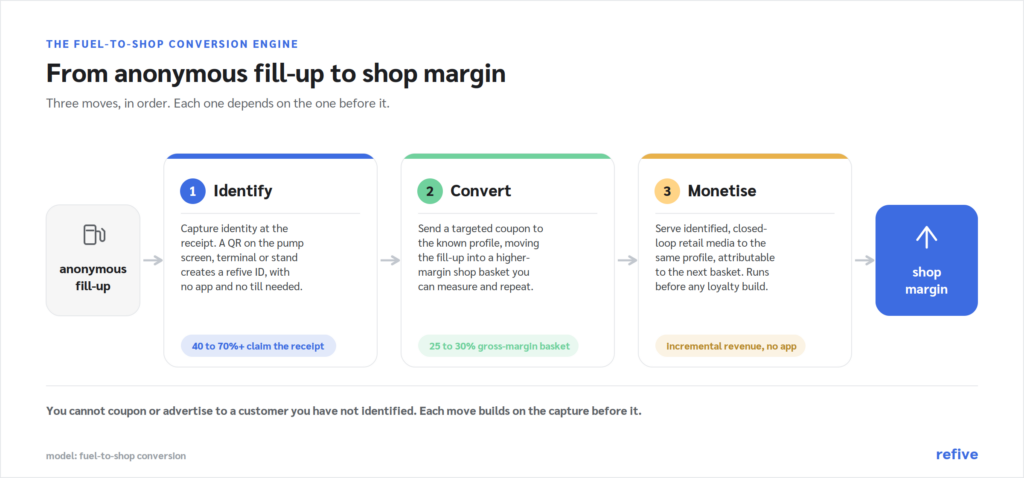
Turning an anonymous fill-up into shop margin takes three moves, in order. Identify the customer at the receipt. Convert them with a coupon into a higher-margin basket. Monetise them through identified retail media. This is the fuel-to-shop conversion engine, and each move depends on the one before it, because you cannot coupon or advertise to a customer you have not identified. The rest of this piece works through them, then adds the EV shift that widens the window for all three.
Identify: make the anonymous fill-up a known customer at the receipt
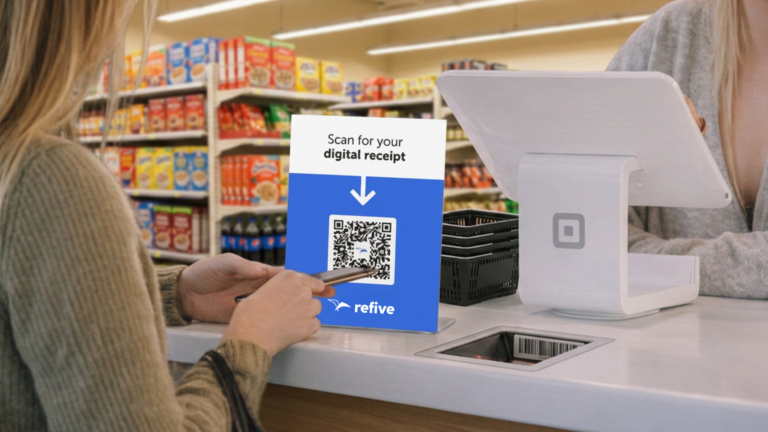
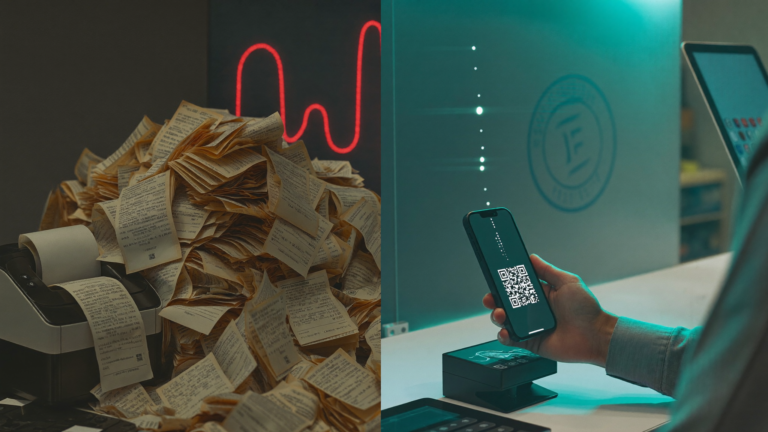
The receipt is the highest-capture identity moment on the forecourt, and it works even when the customer never reaches a till. A QR code on the pump screen, the payment terminal, or a stand turns a paper handover into a digital one. In refive deployments, 40 to 70 percent or more of customers take the digital receipt, and 50 to 60 percent of those give an email and opt in.
How do you identify pay-at-pump and fleet customers without a till?
Through the receipt flow, not the checkout. A dynamic QR on the pump screen, an on-screen prompt, or an app fallback issues the receipt and creates or reconnects a profile, so the capture moment moves to wherever the customer actually pays. No app download is required; the receipt opens in a browser. That single change converts the most anonymous touchpoint on the site into the first line of a customer record.
Each capture assigns or reconnects a customer profile, a Refive ID, that persists across visits. The fill-up stops being a one-time anonymous event and becomes the start of a relationship you can act on.
Convert: coupon identified customers into higher-margin baskets
Once a fill-up is a known profile, a targeted coupon is what moves that customer from the pump into a 25-to-30-percent-margin basket. This is the fuel-to-shop conversion fuel pricing cannot buy: a concrete reason to walk inside, attached to a person you can reach again next week.
A digital receipt is a delivery channel as well as a record. The coffee offer, the meal deal, the wiper-fluid discount can land on the receipt the customer just opened, or in a follow-up message to the profile you captured. Because the offer is tied to a known customer rather than broadcast to the forecourt, you can target by basket, segment, and history, and you can measure who redeemed. For a commercial or operations lead, this is the lever that shows up in forecourt conversion rate and basket size, the two KPIs fuel price cannot touch.
A coupon to an anonymous crowd is a guess. A coupon to a known customer is a campaign. Early on-receipt campaigns show repeat-purchase lift in the single digits; the mechanism is proven, and the longitudinal numbers at fuel scale are still building.
Monetise: identified retail media vs anonymous pump screens
Forecourt retail media today is mostly anonymous. Pump-screen networks broadcast video to a captive but unknown audience and measure on impressions and dwell. Receipt-based retail media is the opposite: it ties an ad to a known customer and a measured basket, it closes the loop, and it runs on receipt capture alone, before any loyalty program exists.
The category is moving fast. In-store retail media spend rose about 47 percent in 2025, and total retail media is projected to pass 100 billion dollars globally by 2027 (BCG and eMarketer). In Europe it grew 22 percent in 2025 against 6 percent for total ad spend, and is on track for 31 billion euros by 2028 (Adtelligent, February 2026). The forecourt is being wired for it: Dover Fueling Solutions launched its 4Court Media network in December 2025 across more than 13,000 Wayne pump screens at launch, alongside GSTV at chains such as Casey’s and Speedway. These are real inventory. They are also blind. A pump screen does not know who is watching, and it cannot tell you whether the person who saw the coffee ad bought the coffee.
What is forecourt retail media, and why is identified media different?
Forecourt retail media is advertising shown on pump screens and forecourt displays, sold to brands as out-of-home inventory. It reaches a captive audience but an anonymous one, so measurement stops at impressions. Identified media, served on the receipt to a known profile, can attribute the ad to the same customer’s next basket. That closed loop is what brands now pay a premium for.
Can a fuel retailer run retail media without a loyalty program?
Yes. Receipt capture creates an identified, opted-in profile on its own, so retail media can run before points, tiers, or an app are live. That makes it one of the earliest incremental revenue layers an operator can switch on, and a reason the receipt earns its place ahead of the loyalty roadmap. For the retail-media owner, this is the difference that sets the rate card: the receipt as a retail media channel is identified and closed-loop where the pump screen is neither.
The EV amplifier: a 20-minute dwell is a shop opportunity, not a fuel stop
Electric charging makes this bigger, not smaller. A petrol fill-up lasts three to five minutes; a charging stop runs 20 minutes or more (McKinsey). That is the difference between a customer who has no time to come inside and one who is looking for a reason to.
As charging displaces fuel, the economics tilt further toward the shop. Margin moves from the pump toward profit-per-kWh, foodservice, and the basket, and the engagement point moves away from the dispenser to wherever the driver waits. A 20-minute dwell is a shop window, a coffee sale, and an identified-media impression with time to land. Networks like Aral are already pairing ultra-fast charging with rewards, and the dwell time is the opening. The operator who has already turned the receipt into an identity layer enters the EV transition with the conversion engine built; the one still relying on pay-at-pump anonymity enters it having lost the till without gaining the customer.
Proof at network scale: the receipt as identity carrier across Orlen
Orlen runs this at scale. Across Orlen’s network of more than 600 stations, refive’s digital receipt operates as the identity layer on a standardised point-of-sale estate, and retail media runs on the same receipt infrastructure. It is a network-wide rollout, not a pilot.
What the Orlen deployment shows is feasibility at network scale: a forecourt operator can capture identity through the receipt across hundreds of franchised and company sites, on the POS systems already in the ground, without a separate app for the customer to download. With capture in place, the couponing and identified-media layers run on the same infrastructure rather than a second project. The rollout is recent and the behavioural data is still accumulating, so the honest read is scale and capability today, with conversion outcomes building as opt-in volume grows. For the fuller forecourt picture, see how fuel retailers are building smart forecourts in 2026.
Model the leak before it drives off again
The margin you are chasing is already on your forecourt. It arrives in every car, stands on the asphalt for a few minutes, and leaves without a name unless something captures it. Fuel buys the visit. Fuel-to-shop conversion, through identification, couponing, and identified retail media, is what turns the visit into shop margin and a customer you can reach again. The question is not whether the demand exists. It is how much of it your current setup lets drive off.
The fastest way to size that is on your own numbers: take your fuel transactions, your current shop-conversion rate, and a realistic capture and coupon-redemption assumption, and model the gap. Model the shop-conversion uplift on your network and see what the leak is costing.
Frequently asked questions
Industry estimates put it at 65 to 75 percent. A 2017 NACS panel cited that range, and GasBuddy’s 2026 survey found about three-quarters of fuel customers say they have no need to go inside. Treat it as a directional estimate rather than an audited figure, but the order of magnitude is consistent across sources.
Fuel is high-volume, near-zero-margin product sold on thin commission, while convenience goods carry 25 to 30 percent gross margin. More than 60 percent of a typical German station’s earnings come from the shop. Foodservice, fresh, and coffee are the highest-margin lines, which is why operators compete on the back-court, not the pump.
Through the receipt, not the till. A QR code on the pump screen, terminal, or stand issues a digital receipt and creates or reconnects a customer profile, so capture happens wherever the customer pays. No app download is needed and the receipt opens in a browser, which is what makes pay-at-pump customers reachable.
Forecourt retail media is advertising on pump screens and forecourt displays, sold as out-of-home inventory to a captive but anonymous audience. Receipt-based retail media serves a known, opted-in profile, so the ad can be attributed to that customer’s next basket. The difference is identification and closed-loop measurement.
Yes. Receipt capture creates an identified, opted-in profile on its own, so retail media can run before points, tiers, or an app exist. That makes it one of the earliest incremental revenue layers an operator can switch on, and a reason to deploy receipts ahead of a full loyalty build.
EV charging extends dwell time from a three-to-five-minute fuel stop to 20 minutes or more (McKinsey), giving customers time to enter the shop and giving operators a longer window to convert and to serve identified media. As charging displaces fuel, margin shifts toward the shop, foodservice, and profit-per-kWh.