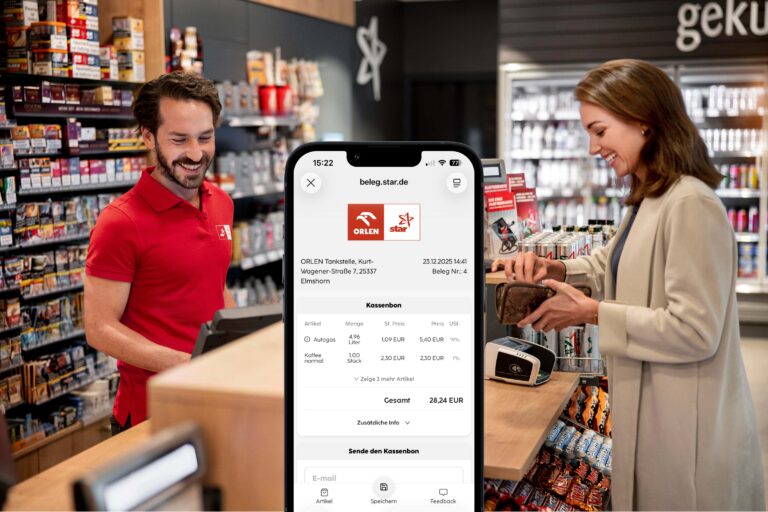

At ORLEN Deutschland’s fuel stations, the receipt now lands on a customer’s smartphone as soon as payment is complete. Before they step out of the station, the receipt is already saved – in the language of whatever device they’re carrying.
ORLEN Deutschland has deployed refive’s digital receipt platform across more than 600 locations. Thermal paper at the till is no longer the default.
What ORLEN Deutschland wanted to change
The fuel station business runs on speed, and the receipt experience had not kept pace. A customer pays, waits for the thermal printout, declines it or forgets it. The receipt is the last thing a customer takes from a station, and the last impression they leave with.
ORLEN Deutschland made the decision to close that gap systematically. Thermal receipts across more than 600 stations mean significant paper waste and a recurring cost for every roll. The customer relationship ended at the till because there was no reliable way to identify a returning customer or stay in contact after the visit. Fleet account customers had to take cumbersome detours to get compliant invoices. Promotions, app sign-ups and seasonal offers had no native channel to land at the moment a customer was actually in contact with ORLEN. And till staff spent real working time regularly changing paper rolls, handing out receipts manually, and reissuing receipts that customers had misplaced.
Going digital was the lever ORLEN Deutschland pulled.
Read the press release: ORLEN Deutschland Introduces Digital Receipts at More Than 600 Fuel Stations with refive
The receipt experience at an ORLEN station
The receipt arrives on a customer’s smartphone as soon as the transaction at the till is complete. There’s no additional waiting moment at the counter for the printer to be ready. No thermal paper lost in a pocket, faded, or hunted down weeks later for an expense claim.
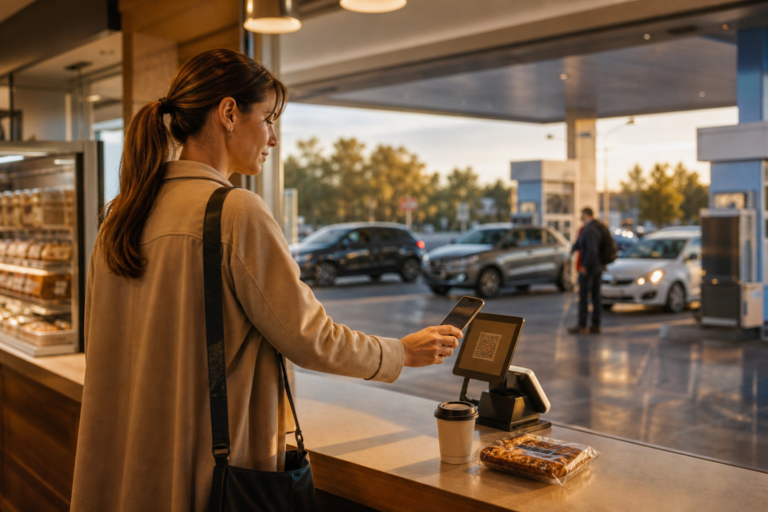
The mechanic is straightforward: after payment, a QR code appears on the payment terminal. The customer scans it with their phone camera. The receipt loads in the phone’s browser, in the language of the device they have with them.
The receipt is also findable later. Through the receipt finder, a customer who needs the receipt three weeks on can pull it up in seconds without contacting the station. A search by date, station and payment details is enough, and the receipt loads in the browser the same way it did right after payment.
On the support side, there is an equivalent. The receipt archive sits in ORLEN Deutschland’s merchant view, where the accounting team can locate any receipt across the entire network whenever a customer actually asks for one. A reissuance conversation takes a moment rather than triggering a back-office process.
The combined effect: the customer rarely needs to ask, and when they do, the answer comes quickly. Reissuance volume drops on both sides.
In an industry where every minute counts, the receipt has moved from friction point to a useful touchpoint in the customer’s browser.
More ways to reach the customer
The digital receipt is also where ORLEN Deutschland can reach the customer who was just there. Every receipt has room for something useful: a seasonal bistro promotion, an invitation to download ORLEN’s tankstar app, or a fleet card offer for business customers who don’t have one yet. The customer sees it once, in context, and can act or move on.
Every receipt also invites customers to rate their visit and leave brief feedback, in the moment when the impression is still fresh. That gives ORLEN Deutschland a continuous read from where it matters most, and customers a simple way to be heard.
For ORLEN Deutschland, the receipt has moved from a piece of paper to a touchpoint with every customer passing through the network.
Fleet customers built in from the start
For a fuel station operator of ORLEN Deutschland’s scale, fleet account customers are a meaningful proportion at every station. Many digital receipt rollouts treat this segment as a follow-on project to be addressed after the main deployment. This rollout made fleet customers a primary use case.
A business customer fills up, goes into the shop, pays with the fleet card, and receives their receipt on their smartphone like any other customer. From that receipt, they generate a fully compliant e-invoice that meets tax requirements, with the company fields already filled in. It takes under a minute. The receipt is the mechanism for the invoice, with no separate back-office process waiting on either side.
For fleet customers, the benefit is clear: no chasing paper invoices at month end that went missing in transit, no manual re-entry into expense systems, no back and forth between fleet management and the station. All of that falls away in the new flow.
Different brands, one experience, one integration
ORLEN Deutschland operates different brands in Germany, including ORLEN and star. These cover different formats: from a full-service site with a shop and bistro to an unstaffed automated station running around the clock.
The receipt experience is the same across all of them.
A driver pulling in from the motorway to a star station gets the same QR code flow at the payment terminal as a driver at an ORLEN site in a city centre. The brand above the forecourt, the prices and the shop format differ. The process for receiving the receipt is the same simple path everywhere.
The refive integration sat on top of ORLEN Deutschland’s existing till system, with no changes to hardware.
The result is a platform serving all brands, live at every station, deployed without touching existing infrastructure.
Less paper, less work for everyone
The environmental impact is one of the consequences of going digital. At full capacity, the rollout is estimated to remove around 36,000 kilometres of thermal paper per year, along with approximately 300 tonnes of CO₂ and 132 tonnes of waste annually.
Thermal till paper is among the materials that are harder to handle downstream. It is not recyclable in standard paper streams, which means most thermal receipts end up in landfill regardless of the customer’s disposal behaviour. Removing paper at this scale is a concrete environmental outcome.
There is a further benefit on the staff side. The single biggest task at a fuel station counter that has nothing to do with fuel is managing receipts: reissuances, lost receipt enquiries, fleet customers looking for invoices for their accounts, changing paper rolls. With a receipt the customer can find themselves, the majority of that work shifts away from the day-to-day at the counter.
Also Read: Why Are Retail Receipts So Long? The Real Mechanics, Europe’s New Rules, and What’s Replacing Them
In line with the broader direction at ORLEN Deutschland
The decision to move every receipt digital fits into a broader direction at ORLEN Deutschland. In recent years, the operator has moved all single-use packaging in the network to compostable materials, expanded HVO100 diesel as an alternative fuel at a growing number of stations, and built out a fast-charging network under the ORLEN Charge brand. The receipt was one of the customer-facing layers that had not yet caught up with the rest.
What this opens up
A digital receipt at every station gives ORLEN Deutschland a foundation that was not there before. After every visit, the operator has a way to reach the customer with something useful: an offer at the station they regularly use, a note about a new service in the area, a seasonal campaign in their preferred language. The receipt is the entry point on which ORLEN Deutschland can now build across its entire German network.