
In October 2024, Poundland launched Perks, the first nationwide rewards app from a UK hard discounter, backed by a £20m investment in new tills and checkout technology. Eleven months later, the app was gone. For discount operators across Europe, the episode appeared to close the question of customer data without a loyalty scheme: if the scheme fails, the data goes with it.
That conclusion deserves a harder look. The fastest-growing retailers in Europe serve tens of millions of shoppers a week and can identify almost none of them. What Poundland’s retreat actually demonstrated is narrower and far more useful: the loyalty scheme was the wrong vehicle. The data was never the problem.
What Poundland’s Perks closure actually proved
Perks did not fail because shoppers ignored it. It failed because a points-and-member-pricing scheme contradicts the economics of hard discount, and the contradiction surfaced within months of launch.
Adoption was never the issue. More than 500,000 customers signed up through Poundland’s digital platforms during the regional pilots alone, according to the company’s October 2024 launch statements. Shoppers will download an app that promises savings. That was never in doubt.
The model strain showed quickly. By May 2025, Poundland had scrapped member-only pricing, telling members it would offer “our very best pricing on the shelf and online” to every customer. The scheme reverted to points alone, and the points economics were stark: a shopper had to spend £50 to earn a £1 voucher. On margins as thin as hard discount runs, a meaningful reward was never affordable.
The end came under new ownership. Gordon Brothers acquired Poundland from Pepco Group in June 2025 and moved to simplify the business, closing 68 stores and exiting online retail. On 16 September 2025, Perks closed with them.
Why did Poundland close its Perks loyalty app?
Poundland closed Perks in September 2025 as part of a restructuring under Gordon Brothers, reverting to a pure everyday-low-price model. Its message to customers promised the best prices for everyone, with “no need for an account, data, membership or vouchers.” Member pricing and points had proven incompatible with single-price discount economics.
Read that closing message carefully. Poundland bracketed data together with accounts, membership, and vouchers, as if the four were inseparable. They are not. That bundling is the assumption this piece takes apart.
The false binary discount retail lives with
Hard discount operates as if there are only two possible states: run a loyalty scheme, or know nothing about your customers. Because the first option is off-brand, costly, and slows the till, the sector defaults to the second and treats anonymity as the price of the model.
There is a third state. Identification without a loyalty scheme means knowing who your customers are, what they buy, and how often they return, without membership, member pricing, points, cards, or apps. The customer identifies themselves once, at the receipt, and every price in the store stays the same for everyone.
The cost of the default is larger than most operators register. In a typical store, the overwhelming majority of customers leave without being identified in any way. In e-commerce, that would be treated as an emergency. In discount retail, where there is usually no online channel capturing identity as a fallback, it is simply the operating condition. TEDi closed its online shop in 2022. Poundland exited online in 2025. For a physical-first discounter, the store is the only place identification can ever happen.
Why loyalty schemes genuinely don’t fit hard discount
The sector’s resistance to loyalty is not backwardness. It is a correct reading of the model. Three structural conflicts make conventional loyalty a poor fit for hard discount, and each one is visible in the Perks story.
Does member pricing conflict with everyday low price?
Yes, directly. Everyday low price is a promise that the shelf price is the best price, for every customer, with no conditions. Member pricing breaks that promise by definition: it creates two prices and tells non-members they are overpaying. Poundland conceded the point itself in May 2025 when it abandoned member prices to offer its best pricing to all customers.
The second conflict is cost and friction. Hard discount wins on lean operations and fast checkout. A loyalty scheme adds app development, points liability, redemption mechanics, and an extra step at the till. Poundland’s £20m outlay bought new checkout hardware largely to make the scheme workable at speed. That is capital a cost-obsessed operator like Action or Woolworth Deutschland would rather put into the next 400 stores.
The third conflict is that the model runs on volume and footfall, and loyalty points reward the wrong behaviour. Discount shoppers already return weekly for the treasure hunt. Paying points to shoppers who were coming anyway is margin given away, which is why the £50-per-voucher maths ended up so thin.
Shopper sentiment offers no rescue. According to the 2025 EY Loyalty Market Study, the share of US consumers who say loyalty programs make them feel more positive about a brand fell from 67% to 50% in a single year, and the share who say programs increase their spending fell from 58% to 43%. Loyalty fatigue is setting in even where the model fits. In hard discount, where it never fitted, the case is weaker still.
The third option: identification at the receipt
Identification and loyalty are separable. A loyalty scheme is a rewards contract. Identification is simply knowing who the customer is. Hard discount rejected the first and, without noticing, threw away the second. Receipt-level identification restores it with none of the parts the sector rejected.
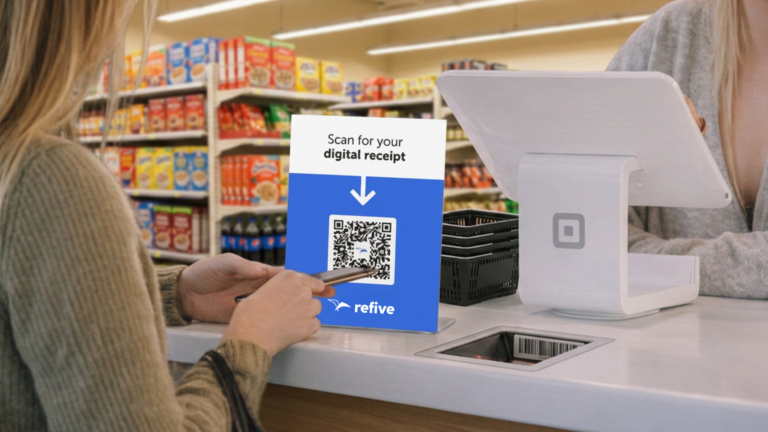
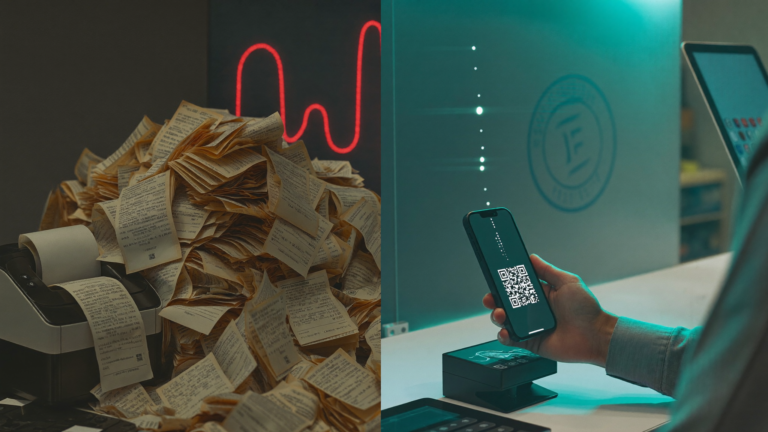
The mechanics are deliberately minimal. A QR code appears on the checkout display the till already has. The shopper scans it with their phone camera and their receipt opens in the browser; paper becomes the fallback for shoppers who ask for it, not the default. No app to download, no card to carry, no account to create at the till, and no change to the checkout flow, so queue speed is untouched. From the receipt, the shopper can opt in to share an email address, and with that single scan a previously anonymous transaction becomes an identified customer with a purchase history. The behaviour it relies on is already routine: scanning a QR code with a phone camera is an everyday action for European shoppers. How QR codes work in retail is by now a solved problem; the shift is putting one at the moment of purchase.
Crucially, the one-price promise stands. There is no member price, because there are no members. Every shopper pays the same shelf price, and the operator still learns who shops.
How do you identify customers without an app or card?
Through the receipt. A QR code presented at checkout links the transaction to the shopper’s phone. Opening it creates an identified purchase record, and an optional email opt-in turns it into a reachable customer profile. The till gains no extra steps, and the shopper installs nothing.
What a discounter does with the data: three uses
Identified footfall has three uses in discount retail: repeat-visit activation, footfall and basket intelligence, and retail media monetisation. Together they convert the sector’s greatest asset, enormous store traffic, into revenue levers that anonymity keeps locked.
Repeat-visit activation. A time-boxed coupon delivered after purchase gives an identified shopper a dated reason to come back, without touching shelf prices or creating permanent member discounts. That suits treasure-hunt retail precisely, because the assortment refreshes constantly and the message writes itself: new range in store this week. It also reaches the majority a branded app never will; we have written before about how digital receipts capture the customers a retail app misses, and in hard discount there is usually no app at all, so the receipt is the only channel there is.
Footfall and basket intelligence. Once even a fraction of transactions carry identity, visit frequency, basket composition, and cross-store behaviour become measurable per customer rather than inferable from till totals. For centralised, KPI-driven head offices, that turns store-level questions, which ranges drive return visits, how new stores cannibalise nearby ones, into questions the data can answer.
Retail media monetisation. High footfall makes discount retail a latent advertising business. Action averaged 21.6 million customers a week in 2025, according to its March 2026 results, across 3,302 stores in 14 countries. Audiences of that size are what advertisers pay for, and identification is what makes the audience targetable and measurable rather than a raw traffic count.
Can discounters run retail media without a loyalty programme?
Yes. Retail media requires an identified, reachable audience and closed-loop measurement, both of which receipt-level identification provides without any membership scheme. For discounters carrying branded goods, the receipt itself becomes sellable ad inventory. The practical constraints are capture volume and advertiser demand, so it scales as identification does.
For hard discount, retail media is arguably the more natural expansion path than loyalty ever was, because it monetises the receipt without introducing the member pricing the sector rejected. The caveat is honest: own-brand-heavy players such as TEDi and Woolworth have a thinner pool of third-party advertisers than a branded-goods discounter like Action or Pepco.
What identification looks like in deployment
The numbers from live deployments are directional but consistent. Before deployment, more than 80% of in-store customers typically go unidentified. Across the retailers refive works with, between 40% and 70% or more of customers then take the digital receipt via QR scan, and 50% to 60% of those who scan go on to share an email address with marketing opt-in. Applied to discount-scale footfall, even the bottom of those ranges builds an identified customer base faster than any loyalty scheme the sector has attempted, at a fraction of the cost and with zero effect on shelf pricing. Regulation is quietly pushing the same direction: France banned automatic receipt printing in 2023, and Italy has committed to phasing out paper receipts from 2027, part of the shift covered in Europe’s move to digital-by-default receipts, so the receipt is becoming digital anyway. The only question is whether it identifies anyone when it does. The underlying in-store customer data capture works with existing POS systems, which matters in a sector that will not add hardware.
The asset was never the scheme
Poundland’s experiment cost £20m and eleven months, and its most valuable output is the clarity of its closing message: hard discount does not want accounts, membership, or vouchers. Nothing in that list requires giving up on knowing the customer. The discounters adding a store a day across Europe are building audiences measured in tens of millions of visits a week, and identification at the receipt is how that audience becomes visible without breaking the model that built it. Seeing it work takes about 15 minutes. Book a look at identification without a loyalty scheme.
Frequently asked questions
Yes. Receipt-level identification lets retailers capture customer identity and purchase history at the point of sale with no membership, points, or member pricing. The shopper scans a QR code to access their digital receipt and can opt in to share contact details, creating an identified profile from an ordinary transaction.
Poundland closed Perks in September 2025 during restructuring under new owner Gordon Brothers, less than a year after its £20m-backed launch. Member pricing conflicted with its single-price promise and was dropped in May 2025; the remaining points scheme was too costly to sustain on discount margins.
A QR code at checkout links each transaction to the shopper who scans it. Opening the receipt creates an identified purchase record, and an optional email opt-in adds a reachable contact. Repeat scans connect successive purchases to the same profile, building purchase history without any app, card, or account.
Yes, when built on consent. The shopper actively scans the code and explicitly opts in before any contact data is stored, which aligns with GDPR’s consent requirements. Consent is captured at the moment of identification, by the shopper’s own action, rather than assumed after the fact.
No. There are no members, so there is no member price. Every customer pays the same shelf price, preserving the everyday-low-price promise. Identification changes what the retailer knows, never what the shopper pays, which is what distinguishes it from the loyalty schemes hard discounters reject.
A loyalty program is a rewards contract: points, tiers, and benefits in exchange for membership. Customer identification is only the knowledge layer: who bought, what, and when. Loyalty programs need identification to function, but identification works on its own, without rewards mechanics or their costs.
No. The code appears on the existing checkout display, and scanning happens on the shopper’s phone after payment completes. There is no added checkout step, no staff interaction, and no new hardware, so transaction speed stays exactly where a discounter needs it.