
From October 1, 2026, digital receipts in Austria count the same as paper at every checkout. The Cash Register Package (Registrierkassenpaket), passed by the Nationalrat on December 10, 2025, makes a receipt shown as a QR code on a display legally equivalent to a printed one, with no amount cap and no obligation on anyone. Europe has seen receipt lotteries before (Italy’s has run since 2021), but no country has framed receipt digitisation this way: no ban, no mandate, just permission, plus a proposed receipt lottery as the sweetener, and that bill is still stuck in parliament as of July 2026.
If you run stores in Austria, or sell to people who do, the reform changes what happens at your till from October regardless of what parliament does next. This piece covers what is already law and what it changes at the checkout, how Austria’s route compares with France, Italy and Germany, what to fix before October, why the digital receipts Austrian retailers already issue leave most shoppers unidentified and how to close that gap, and, last because it is still only a bill, how the planned Beleglotterie would work if it arrives.
What is Austria’s Cash Register Package 2026 and what does it change for digital receipts?
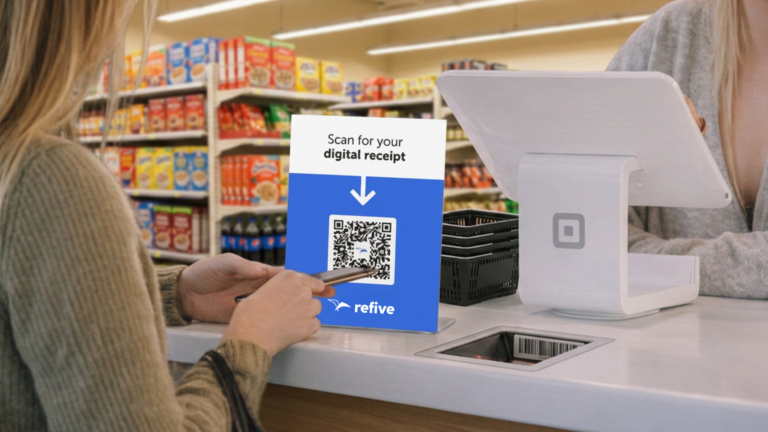
The measure that matters most to retailers takes effect on October 1, 2026. From that day, the receipt issuing obligation (Belegerteilungspflicht) counts as fulfilled when the receipt content is displayed digitally, for example as a QR code or link on the checkout screen that the customer scans or photographs. No amount limit applies, and email delivery is no longer required. You can stop printing for every customer who does not ask for paper, at every basket size, which also removes a small but real cost: industry estimates put the saving at roughly 0.02 euros per receipt against paper, before printer maintenance. The provision passed the Nationalrat on December 10, 2025 through an amendment to the Abgabenänderungsgesetz 2025.
Two smaller measures took effect on January 1, 2026, and matter mainly to small and open-air merchants: the turnover threshold for the cold-hands rule (Kalte-Hände-Regelung), which exempts businesses like market stalls and mountain huts from the cash register obligation, rose from 30,000 to 45,000 euros net per year, according to the Austrian federal business service portal USP.gv.at, and the 15-product-group rule for small retailers, previously renewed year by year, was made permanent.
Two things do not change. Customers, and tax auditors, keep the right to demand a paper receipt. And the reform changes how a receipt is delivered, not the fiscal security regime behind it: the machine-readable code and signature requirements under Austria’s cash register security framework (RKSV) that have applied since 2017 stay in place. Handelsverband managing director Rainer Will welcomed the package as strengthening freedom of choice for customers and retailers alike while finally creating permanently clear rules for businesses.
How does Austria’s digital receipt rule compare with France, Italy, and Germany?
Among Europe’s receipt reforms, Austria is the first to offer prize money instead of obligation rather than on top of it, and the purchase has not cleared parliament yet.
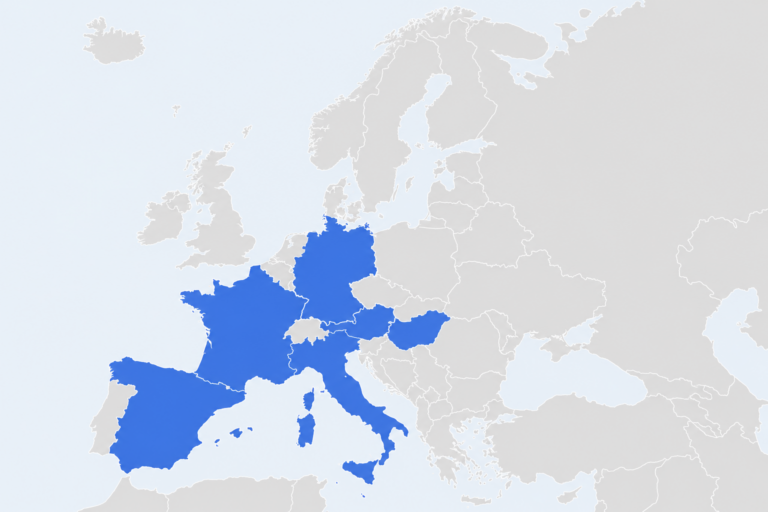
France prohibited automatic receipt printing on August 1, 2023 under the AGEC anti-waste law; receipts are printed only on request. Italy is moving in the opposite direction of Austria on obligation: a law in force since January 2026 requires POS terminals to be linked to certified cash registers, with fines of 1,000 to 4,000 euros for violations, and a parliamentary resolution (8-00081) sketches a phased transition to digital receipts across 2027 to 2029. That timeline is a resolution, not yet enacted law. Italy also already runs a receipt lottery: the lotteria degli scontrini has drawn weekly winners since February 2021 and paid participants 36.5 million euros in 2025. But it sits on top of Italy’s mandates, rewarding cashless payment inside an already compulsory e-receipt system, and its promised instant-win version has been stalled for over three years on an unfunded prize pot, after 1.6 million merchants had upgraded their registers for it. A state incentive announced is not a state incentive delivered, in Rome or in Vienna. Germany still requires a receipt to be issued for every transaction under its Bonpflicht, with fiscal security governed by the KassenSichV regime, and offers no lottery and no ban.
Austria’s bet is distinct: keep the obligation to issue, liberalise the format, and use prize money for the adoption work that other countries assign to inspectors. Until the lottery bill passes, that bet runs on permission alone. For a retailer operating across borders, the practical read is that Austria is the easy end of a one-way street: nothing forces a change there, but all four markets point the same direction, and a checkout built for digital receipts in Vienna is the same checkout France already requires and Italy is moving toward. For a fuller breakdown of what sits on European receipts and how the rules diverge, see our piece on why retail receipts are so long and what is replacing them.
How should retailers prepare for digital receipts before October 1, 2026?
Four decisions cover most of the preparation, and none of them requires waiting for October.
First, confirm cash register software readiness. The digital receipt must carry the same RKSV-compliant content as paper, displayed long enough at the point of payment to be scanned or photographed, so the capability depends on your POS or cash register provider shipping the update. Second, design the checkout flow: where the code appears (customer display, payment terminal, static stand), what staff say, and how the paper fallback works, since the customer’s right to a printed receipt remains. Third, track the Beleglotteriegesetz, the pending receipt lottery bill covered at the end of this piece; if it passes, scan volumes jump, so design the checkout flow so that attention lands on something you control rather than a bare code. Fourth, decide the data question now: does the scan end at receipt delivery, or does it start a customer profile? That choice, more than any compliance detail, determines what the reform is worth to you.
Which Austrian retailers already issue digital receipts?
Austria’s two grocery giants moved before the law did, which means shopper expectations in your market are already being set. SPAR offers a digital receipt through the SPAR-App, replacing the printed Kassenbon for app users. REWE International brought the digital receipt to its jö Bonus Club app in September 2024, covering Billa, Billa Plus, Bipa, Penny and Adeg across more than 2,300 Austrian locations, as reported by the trade publication Cash at launch. REWE put the scale of the problem in context at the time: Austrian retail processes around seven million transactions a day.
Look closely at both deployments, though, and a structural limit appears. Each digital receipt is app-gated. jö’s version reaches club members; SPAR’s requires the SPAR-App, even though registration there is deliberately light and SPAR states it does not analyse purchase behaviour. Either way, a shopper without the app still gets paper, and the retailer learns nothing about them. That is the wider pattern: by industry estimates, more than 80 percent of in-store customers leave the store without being identified. App-based receipts digitise the slip for the installed minority. They do nothing for the anonymous majority, and the anonymous majority is where the commercial upside of this reform sits.
Turning digital receipts into customers you can reach again
A bare compliance QR satisfies the law and wastes the moment. The shopper is already standing at your checkout, phone in hand, and whether or not the state ever pays them to scan, what loads when they do is entirely the retailer’s choice.
This is where refive sits. The refive digital receipt is delivered exactly the way the new law describes: a QR code on the checkout screen, the payment terminal, or a static stand at the till, with NFC tap and an email fallback where needed. It opens in the browser. No app to install, no loyalty membership as a precondition, which is the structural difference from app-gated receipts: it works for the anonymous majority, at the exact moment they interact with the store.
What happens after the scan is where the platform earns its place. The first scan creates an anonymous customer profile, a Refive ID, before the shopper has shared a single detail. From there, profiling is progressive: the receipt page invites an email or WhatsApp address with an explicit marketing opt-in, offers one-click loyalty enrolment instead of a sign-up form, and can carry a personalised offer based on the basket, the segment, or the purchase history it already knows. The same page collects feedback and routes satisfied customers toward a Google review, and it fires attribution pixels for Google and Meta, so a store visit finally shows up in the same measurement world as a website session. The legally required receipt content is preserved throughout: refive’s digital receipts are built for legal compliance across more than 20 European countries, and that fiscal content is the floor the engagement sits on.
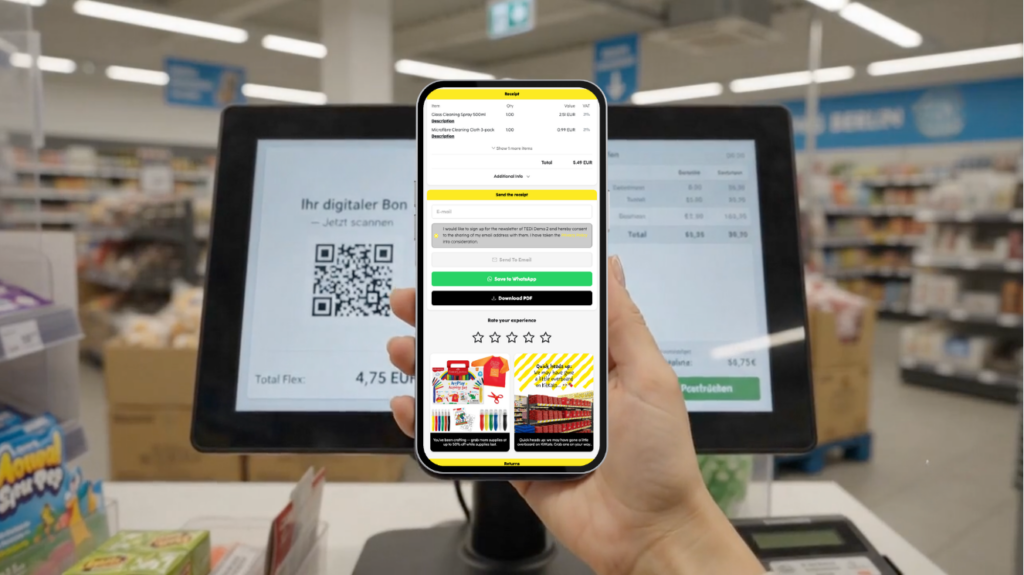
The numbers from live deployments are the reason to take the moment seriously. Across refive rollouts, 40 to 70 percent or more of customers take the digital receipt via QR, and 50 to 60 percent of those scanners leave an email address with a marketing opt-in. For a retailer where 80 percent of in-store customers are currently anonymous, that is the anonymous majority converting at the till, transaction by transaction.
How it fits an existing stack depends on the retailer. Enterprises run refive as an integration layer, feeding receipt-captured identity and purchase data into the CRM, CDP, or loyalty system they already own via API. Mid-market retailers without that infrastructure run the full platform: customer profiles, campaigns over email, WhatsApp and Wallet Pass, a loyalty programme, digital coupons and gift cards from one vendor. Either way, deployment is measured in weeks rather than quarters, which matters with October 1, 2026 fixed in the calendar.
Austria’s planned receipt lottery: still a pending bill
The Beleglotterie is the government’s attempt to give shoppers a reason to engage with the receipt, and it is worth understanding precisely because it has not passed. Introduced as parliamentary initiative 630/A by the governing ÖVP, SPÖ and NEOS on December 10, 2025, the bill as drafted would run from October 1, 2026 to the end of December 2029: 100 participants drawn monthly, each winning a tax-free 2,500 euros, with bonus draws capping the annual payout at around four million euros, according to the Austrian parliament’s analysis of the bill. Shoppers would submit receipts through the FinanzOnline app or by providing an email address, per the parliamentary correspondence on the bill.
The status is the point. Committee consultation drew 34 written submissions, the Finance Committee deferred the bill unanimously in January 2026 over open technical and legal questions, with pensioner associations among the vocal critics according to OÖNachrichten’s January 2026 reporting, and a vote planned for February never appears in the parliamentary record. By late March, the finance ministry told Austrian media that a start date can only be fixed once the open questions are resolved. As of July 2026, the Beleglotterie is a pending proposal with an officially uncertain start, and nothing in this piece depends on it passing.
If it does pass, the code on every Austrian receipt becomes a lottery ticket and scan volumes jump on a date the ministry has yet to fix. But an incentive does not have to come from the state. Convenience, instant loyalty value, or an offer waiting on the receipt do the same work at retailer scale, and until parliament votes, the only incentive at the till is whatever the retailer puts behind the scan.
Austria has fixed the date the digital receipt becomes paper’s equal. Whether the state ends up paying shoppers to scan is still an open vote in parliament. The retailers who make the scan worth taking on its own will never need the lottery to make the moment pay.
See what your checkout’s scan could carry. Book a demo.
FAQ: Austria’s digital Kassenbon and the 2026 Cash Register Package
No. From October 1, 2026 a digitally displayed receipt is a valid substitute for paper, with no amount cap, but the choice stays with the retailer and the customer. Customers and tax authorities keep the right to request a printed receipt at any time.
Yes. The digital receipt is an equal alternative from October 1, 2026, and the printed receipt remains available on request at every checkout. The customer decides the format at the point of payment, and tax authority officers can also require a paper receipt during an inspection.
The Beleglotteriegesetz, still before parliament as of July 2026, would let shoppers submit receipt codes through the FinanzOnline app or by providing an email address. Each month 100 participants would win a tax-free 2,500 euros, with up to two annual bonus draws of 250,000 euros each, running to the end of 2029 as drafted.
Yes. Because a digital receipt opens in the browser, it can carry loyalty enrolment, personalised offers, product information, and feedback collection alongside the legally required content. The receipt becomes the highest-frequency digital touchpoint a physical store has, reaching customers no app-based programme captures.