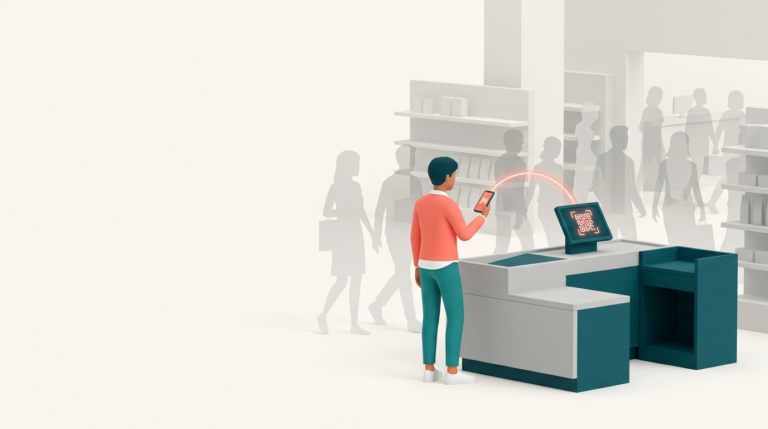

The same drivers come back every week. Your site can’t tell.
An Autohof has the most recognisable customers in fuel retail. Professional drivers on fixed lines run the same stretch of the A7 or the A9 week after week. The rest rules make them stop on it, and they stop here. The owner knows them by face, by truck and by order. Nothing else on the site knows them at all.
Not every truck is a regular. In 2025 tolled commercial vehicles covered 40.5 billion kilometres on Germany’s toll network, according to the toll statistics of the Bundesamt für Logistik und Mobilität. The regulars are a smaller group, and an Autohof owner can point to them in his car park on any given night. The obvious objection is that the fleet card already records who fuels here.
The fleet chooses the network. The driver chooses the stop.
A fleet card decides where a driver may fuel. The haulier picks the card (DKV, UTA, Shell Card, Aral, LogPay or Eurowag) and with it a network and a price, and the card issuer bills the haulier in one consolidated statement. The operator settles with the issuer, and what comes back is a settlement for fuel, not a customer.
Mobil in Deutschland’s 2025 comparison of posted pump prices at ten paired sites put 50 litres of diesel at an average of 80.91 EUR at the Autohöfe against 103.13 EUR at the motorway Raststätten. Fleet-card rates are not posted prices, but a gap that size plausibly explains why a haulier keeps his drivers off the motorway. It does not explain why the driver picks this exit over the next on the same network.
Within the network his employer has set, the driver decides where to spend his 45-minute break and where to park for the night, as far as his remaining hours and the free spaces allow. Drivers use that choice: about half of the roughly 100 professional drivers surveyed for DEKRA’s 2026 Road Safety Report said they deliberately avoid certain rest areas after break-ins, cargo theft, vandalism or assaults, and respondents asked for clean sanitary facilities and reasonable charges. Free space narrows it: more than half regularly drive more than 20 kilometres extra to find a place to stop. The card scheme holds the account and the fuel; the driver, on this site, is nobody’s customer. Beyond the pump the card explains little: at most it settles a parking fee, and even then it records a card, not the driver. The shop and the restaurant are typically paid on his own card or in cash, and they do not know him either.
One driver, four tills, and nothing that connects them
On a typical Autohof the same driver pays four times in one stop: at the pump, at the shop till, at the restaurant, and for the parking space. The forecourt system (Hectronic, HUTH or Scheidt & Bachmann) closes the fuel sale; the shop till, the gastronomy system and the parking gate each close their own.
Where the pump and the shop share a till it changes nothing. A combined forecourt system records a card number against a fuel sale and a coffee, and nothing links that card to his next visit. The owner can say to the euro what the site sold yesterday. He cannot say who bought four times, because no system on the site was ever asked to.
So the pump belongs to the card scheme and the rest of the site belongs to nobody, even though the rest of the site is where the shop and restaurant margin sits.
Recognise, reward, re-reach: what a regular gets that a stranger does not
Once the site can tell a regular from a stranger, three things become possible, and each has a specific shape on an Autohof: he is recognised at every till on the site, rewarded with something he wants, and reachable between visits.
Recognise. A Stammfahrer, a regular driver, is treated as one at the pump, the shop till, the restaurant and the parking gate, whoever is on shift. The status means something on an Autohof because his visits repeat; the operator sets how many it takes.
Reward. The strongest reward on an Autohof is a parking space. Germany was 19,627 truck spaces short on and near the Autobahn in the 2023 count by the Bundesanstalt für Straßenwesen (BASt), the federal highway research institute; the 2018 count showed a larger gap, but BASt measured capacity differently in the two surveys, so the two figures do not show the shortage closing. A driver who has to stop tonight and does not know where he will find a space values a held one: in the same DEKRA survey, 43 per cent said the search takes 30 to 60 minutes on average and a further 24 per cent longer than an hour. Behind it sit the smaller rewards: a shop offer before his break, a restaurant deal for the drivers who arrive in a known window. The receipt layer recognises the regular; the operator holds the space and decides who gets it.
Re-reach. A driver who has left an email address or added a Wallet Pass can be reached on Monday about the Tuesday stop, which today nobody on the site can do.
The fuel invoice goes to the haulier and is a business document. The driver’s email address is his own personal data, and using it for offers rests on his separate consent: Art. 7(4) GDPR weighs heavily against consent that is made a condition of the receipt itself, and § 7(2) Nr. 2 UWG requires express consent before email advertising.
Every item on that list depends on one moment where the driver chooses to be recognised, at the point of paying. He needs a reason to, and the site needs something for him to scan.
The receipt is the one thing every till already hands over
Every till on an Autohof already issues a receipt, and German law lets it be electronic. § 6 KassenSichV allows an electronic receipt with the customer’s consent, which under the Bundesfinanzministerium’s application decree to § 146a AO needs no particular form and can be implied. The ministry’s FAQ on the receipt obligation, updated in April 2026, confirms that a download link shown as a QR code on a customer display meets the obligation, as does a receipt sent by email or to a phone. A pay-at-pump terminal or parking machine without a cash-register function falls outside that obligation, so a receipt there is the operator’s choice.
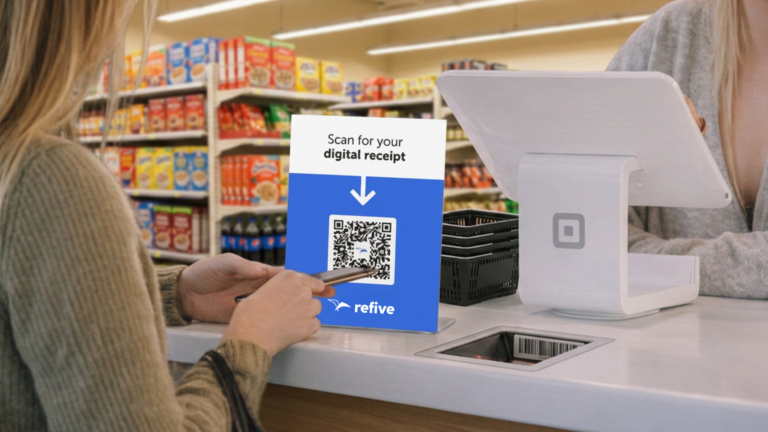
The mechanic is a scan at the pump, the till, the table or the gate that opens the receipt in the driver’s browser, without an app or new hardware. For a driver off his usual network, or paying by corporate card, the same scan carries the compliant invoice he needs. For the DKV or UTA cardholder the invoice already arrives through the card, so the reason to scan is what sits behind it: the Stammfahrer status, the held space, the offer for tonight. Whether he leaves an email is his decision, made on his phone. Each time he scans after that, the visit is filed under the same regular rather than a new stranger. That layer, Wallet Pass included, is what refive supplies; the tills and the space stay the operator’s.
The receipt scan already runs at forecourt scale. In June 2026 ORLEN Deutschland introduced digital receipts across more than 600 ORLEN and star fuel stations through a single integration, with compliant e-invoices for fleet accounts and no change to existing hardware.
Somewhere on the A7 tonight a driver is parking at the same Autohof he has stopped at every Tuesday for six years. The restaurant staff know his order. The pump, the till and the gate will record him, one more time, as someone they have never seen.
A walkthrough of the receipt flow takes 30 minutes.